KitchenAid 7-Cup Food Processor Review: Worth It? (November 2026)
The KitchenAid 7-cup food processor suits everyday vegetable prep, cheese shredding and sauces, with accessories that store inside its bowl. Choose the KFP0718 for manageable dinner prep; choose a larger model for frequent batch cooking or adjustable slicing.
On this page (9 sections)
- Who should buy the KitchenAid 7-Cup food processor?
- Is a 7-cup bowl enough for your recipes?
- What do the blade, disc and controls change?
- How should you set up the KFP0718 for dinner prep?
- What mistakes should you avoid with this processor?
- Will the KFP0718 fit your counter and storage space?
- How should you clean the KitchenAid 7-cup food processor?
- Which alternative solves a specific KFP0718 limitation?
- Should you choose the KitchenAid 7-cup food processor?
The KitchenAid 7-cup food processor is a good fit for everyday dinner prep if you want to chop vegetables, shred cheese and make sauces without storing loose attachments. Choose the KFP0718 when your usual recipes fit its bowl and you don't need adjustable slicing thickness.
Its appeal is straightforward: useful prep tools, a bowl that clicks into place and accessories that stay together between meals. Frequent batch cooks should look at the larger alternatives below before deciding.
Who should buy the KitchenAid 7-Cup food processor?
Buy the KFP0718 for several prep jobs within one meal, especially when chopping by knife and grating by hand slow you down. Skip it if your main goal is large-volume prep or choosing different slice thicknesses.
KitchenAid 7-Cup KFP0718: Best for everyday dinner prep
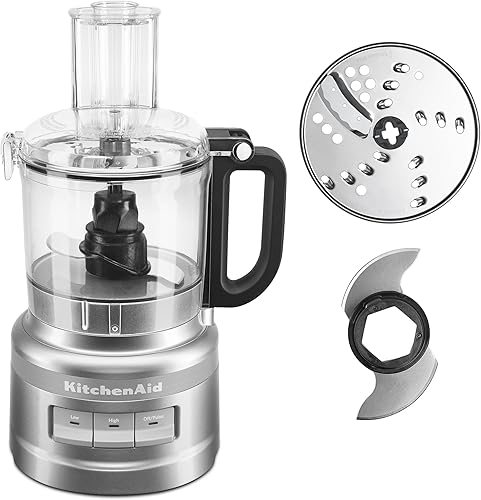
- 7-cup work bowl
- High, Low and Pulse controls
- Reversible medium slicing/shredding disc
- In-bowl accessory storage
Choose this KitchenAid for dinner prep that fits comfortably in one bowl. Its twist-free assembly and in-bowl accessory storage suit cooks who want straightforward setup and fewer loose parts.
Pros
- Included blade and disc store inside the bowl
- Pulse helps control chopping texture
- 2-in-1 feed tube accepts different ingredient shapes
- Twist-free bowl assembly with a latched lid
Cons
- Frequent batch cooking may require a larger bowl
- Slicing thickness is not adjustable
- Dough-focused buyers should confirm the included accessories
Think of a dinner that needs chopped onion, shredded cheese and sliced cucumber. A processor can handle those separate jobs, provided you plan the order and empty the bowl between tasks.
It makes less sense for a cook who usually chops half an onion and nothing else. Taking out the machine, assembling it and washing the parts may outweigh the time saved on a tiny job.
Where the KitchenAid 7-cup food processor fits best
This model suits cooks who want one appliance for chopping and disc work. A basic chopper can handle small batches of chopped ingredients, but slicing and shredding call for the right disc.
The KFP0718 includes a multi-purpose blade and a reversible medium slicing/shredding disc. The disc covers routine salad and cheese prep, but it won't let you dial in a thin cucumber slice and then a thick potato slice.
For meal ideas that use these tools, see what you can make in a food processor. Choose recipes you already cook rather than buying around tasks you might try once.
Is a 7-cup bowl enough for your recipes?
A 7-cup bowl is enough when your normal prep fits within its working limits, with room for ingredients to move. The stated capacity isn't a promise that you can process that much liquid, dough or whole produce at once.
Judge size by your busiest regular recipe. If you normally prepare vegetables for one dinner, a moderate bowl can be practical; if you prep several dinners together, repeated emptying becomes part of the job.
There are also 2 different ways a bowl fills. Chopped food takes up space around the blade, while sliced or shredded food collects beneath the disc and eventually needs emptying.
For sauces, follow the liquid limits in the manual. A leak-resistant bowl still has operating limits, so don't fill it to the rim or assume every mixture can reach the same level.
When does a larger bowl earn its space?
Move up when splitting your usual recipe interrupts the work. An occasional second batch is manageable, but doing several batches every week is a reason to choose more capacity.
Don't select size only by the number of people at home. A cook preparing a large slaw for 2 people may need more room than someone making a small sauce for a family.
Our food processor size guide helps match capacity to recipes. The complete food processor buying guide explains how bowl size fits alongside attachments, controls and storage.
What do the blade, disc and controls change?
Use the blade for chopping and pureeing, and the disc for slices or shreds. Choosing the correct attachment matters more than running the machine longer.
With the blade, start with evenly sized pieces so smaller bits don't turn to paste while larger pieces remain whole. Short pulses let you stop and check the texture before a coarse salsa becomes a smooth sauce.
For disc work, trim food to fit the feed tube and use the pusher. Keep fingers and utensils out of the tube, and avoid forcing an oversized piece through.
The KFP0718 has High, Low and Pulse controls, with easy-press paddles and illuminated LEDs. Pulse is especially useful when you want to approach the final texture in small steps.
Its 2-in-1 feed tube accommodates different ingredient shapes. You may still need to trim potatoes, cucumbers or other produce, so don't treat the tube as a substitute for all knife work.
Read our guide to food processor blades and discs if you're unsure which tool a recipe needs. It also helps distinguish a useful extra attachment from one you'll rarely use.
Should you buy it mainly for dough?
Choose around confirmed dough tools and recipe limits if kneading is your main reason to buy. The KFP0718's accessory descriptions conflict, so confirm its package contents before ordering rather than assuming a dough blade is included.
The larger KitchenAid below explicitly includes that attachment. Even then, a dough blade doesn't remove batch limits or mean every bread recipe belongs in the bowl.
Our guide to making dough in a food processor explains the method and its limits. Dough work should guide your choice from the start if you'll do it often.
How should you set up the KFP0718 for dinner prep?
Set it on a dry, level surface, assemble the correct attachment with the power disconnected and secure the bowl and lid before use. The twist-free, one-click bowl assembly and latched lid simplify that routine.
Plan the order before loading food. Slicing a cucumber before making a wet sauce can save an extra wash, while a strong-flavored ingredient may call for cleaning before the next task.
Use this sequence for a smoother start:
- Read the assembly and food-limit instructions in the manual.
- Remove stored accessories and fit only the tools required for the task.
- Trim ingredients into pieces that fit the bowl or feed tube.
- Secure the lid, then connect power and process in short stages where texture matters.
- Disconnect power before changing attachments, scraping by hand or emptying around the blade.
If the machine won't start, switch it off and check the bowl and lid placement. Don't force parts into position or try to bypass a safety lock.
For more on loading, pulsing and changing tools, follow our guide to using a food processor.
What mistakes should you avoid with this processor?
Avoid overfilling, uneven loading and running past the texture you want. These habits can create extra work even when you've chosen the right bowl size.
Loading large and small pieces together: Cut ingredients to a similar starting size for chopping. Process hard and soft foods separately when they need different amounts of work.
Using continuous operation for every job: A coarse chop needs close attention. Stop early, inspect the food and add another pulse only if needed.
Letting food pack beneath the disc: Empty the bowl before collected slices or shreds crowd the working area. Switch off and disconnect power before opening it.
Expecting every mixture to circulate on its own: Sticky ingredients may cling to the bowl wall. Stop, unplug and use a spatula as needed rather than reaching into a running processor.
Buying for one rare task: Choose around the work you repeat each week. A machine that fits your normal meals is more useful than extra capacity or attachments bought for an occasional project.
Will the KFP0718 fit your counter and storage space?
Check height, footprint and access above the lid before choosing a storage spot. The KFP0718 measures 7.87 in deep, 9.65 in wide and 15.35 in high, and weighs 6.6 lb.
A shelf that fits the assembled appliance may not leave enough room to remove the lid or feed ingredients. If it will sit beneath a cabinet, allow space to pull it forward for use.
The included blade and disc store inside the bowl, which keeps them together. Dry the parts fully before packing them away, and remove them carefully when you next assemble the machine.
Think about the route from storage to the counter, too. A convenient spot near your prep area can matter more than saving a little shelf space in a distant cupboard.
How should you clean the KitchenAid 7-cup food processor?
Clean it soon after prep, before sauce and food scraps dry onto the parts. Disconnect power before disassembly and keep the motor base out of water.
KitchenAid describes a cleaning method using warm water and 1–2 drops of dish soap in the leak-resistant bowl. Follow the manual's procedure, then check for food caught around the lid, feed tube and attachment fittings.
The KFP0718 has a dishwasher-safe care designation. Use the manual's part-by-part instructions and rack guidance rather than putting every component in together.
Handle the blade and disc by their safe gripping areas, keeping clear of the cutting edges. Don't leave sharp attachments hidden beneath sudsy water.
Our guides explain how to clean a food processor and which food processor parts are dishwasher safe. Let everything dry before returning the accessories to the bowl.
Which alternative solves a specific KFP0718 limitation?
Choose an alternative for a task or capacity the KFP0718 doesn't cover, rather than moving up simply because the bowl is bigger. These 3 options address different needs.
The KitchenAid 13-Cup KFP1318 is the clearest step up for weekly batch cooking. Its externally adjustable slicing disc lets you change thickness, and it also includes a reversible shredding disc and an in-bowl storage caddy.
Skip it if large batches are rare and storage is tight. At 8.75 in deep, 10.25 in wide and 17.44 in high, it needs more room than the smaller KitchenAid.
The Cuisinart suits cooks who want 2 slicing discs, a separate shredding disc and a chopping/mixing blade. Its single-speed setup keeps the control choice simple.
Skip it if you frequently lift appliances from a low cabinet. Its 16.9 lb weight makes a regular counter position worth planning.
The Hamilton Beach 70730 suits frequent sauce prep because its built-in scraper moves from side to side without removing the lid. That feature addresses a specific inconvenience: stopping to move food off the bowl walls by hand.
Choose another model if adjustable slicing thickness is your main goal. Its slicing/shredding disc and chopping/pureeing blade cover routine tasks, while 2 speeds plus Pulse provide control.
For more sizes and features, browse our best food processors. If the brand choice is still open, see Cuisinart vs KitchenAid food processors.
Should you choose the KitchenAid 7-cup food processor?
Choose the KitchenAid 7-cup food processor for regular dinner prep when its bowl fits your recipes and medium slicing meets your needs. Its organized accessory storage is most useful when you'll take it out often.
Choose the larger KitchenAid for batch cooking, adjustable slices or an explicitly included dough blade. Pick the Cuisinart for its disc selection, or the Hamilton Beach when scraping sauce ingredients off the bowl walls is a recurring chore.
Before ordering, write down your 3 most common prep jobs and check that the bowl and tools cover them. Use our best food processors guide if those jobs point toward a different size or attachment set.
Frequently asked questions
What can the KitchenAid 7-Cup KFP0718 do?
The KitchenAid 7-Cup KFP0718 chops, slices, shreds and purees using a multi-purpose blade and reversible medium slicing/shredding disc. It suits vegetable prep, cheese, sauces and salsa.
Use short pulses for a coarse chop, and choose the disc when you want slices or shreds rather than chopped pieces.
Are the KitchenAid KFP0718 parts dishwasher safe?
The KFP0718 has a dishwasher-safe care designation, but check its manual for each part and rack placement. KitchenAid also describes a bowl-cleaning method using warm water and 1–2 drops of dish soap.
Unplug before disassembly, handle sharp edges carefully, and keep the motor base out of water.
How much does the KitchenAid KFP0718 hold?
The KFP0718 has a 7-cup bowl, but usable batch size depends on the food and the manual's limits. Loose vegetables, chopped ingredients and liquids need different amounts of working room.
Choose a larger processor if your usual recipe repeatedly requires you to stop, empty the bowl and reload.
Does the KitchenAid 7-Cup KFP0718 include a dough blade?
Don't assume a dough blade comes with the KFP0718: its accessory descriptions conflict, while its model-specific contents name a multi-purpose blade and reversible disc. Confirm the package contents before ordering if dough matters.
The KitchenAid 13-Cup KFP1318 explicitly includes a dough blade; follow its recipe and batch limits.


