5 Best Cuisinart Food Processors (November 2026)
The best Cuisinart food processors include the Cuisinart 14-Cup Food Processor for large batches, the Cuisinart Mini Food Processor 3-Cup for small prep jobs, and the Cuisinart 11-Cup Food Processor for everyday meal prep.
On this page (10 sections)
- How we chose the best Cuisinart food processor
- Cuisinart food processor comparison
- Which Cuisinart processor fits your kitchen?
- How much bowl capacity do you actually need?
- Which blades and discs should drive your choice?
- What should you measure before buying?
- How do you set up a Cuisinart food processor for useful results?
- How do you keep cleanup manageable?
- Which common buying mistakes should you avoid?
- Which is the best Cuisinart food processor for your routine?
The best Cuisinart food processor for large batches is the Cuisinart 14-Cup Food Processor. Choose the Mini Food Processor 3-Cup for small chopping jobs, or the 11-Cup if you want a full-size machine with two slicing options.
For a compact kitchen, the key choice is between a small chopper and a processor with a shredding disc. The 5-Cup Chop & Shred covers the latter, while the Small 4-Cup focuses on chopping, grinding and puréeing.
Start with the meals you make each week. A machine that handles those jobs without repeated batches or awkward storage is a better buy than one chosen for bowl size alone.
Our picks at a glance
-
1

-
2
-
3

- 4
 Best for small kitchensCheck it
- 5
 Check it
Cuisinart Small 4-Cup Food Processor
Best for small sauce batches
How we chose the best Cuisinart food processor
The best Cuisinart food processor should match your batch size and cutting tasks. We compared bowl capacity, included tools, controls, storage and care instructions, with the highest score going to the most complete choice for larger prep jobs.
The ranking includes two different kinds of appliance. Disc-equipped processors can slice or shred food, while the mini choppers focus on breaking ingredients down with a blade.
That difference matters more than a small gap in scores. A compact chopper can be the right choice for pesto even if a full-size processor ranks higher for broader kitchen use.
We also considered what happens between meals. Weight, loose attachments and washing needs affect how often a processor earns its counter space.
Cuisinart food processor comparison
The 14-cup model provides the most batch room, while the 11-cup model offers two slicing choices. The smaller models divide into a compact shredding option and two chop-and-grind options.
Use the table to check tools before choosing a size. A larger bowl won't replace a missing attachment, and a reversible chopping blade isn't the same as a reversible shredding disc.
| Product | Best for | Bowl capacity | Motor | Included blades and discs | Our score |
|---|---|---|---|---|---|
| Cuisinart 14-Cup Food Processor | large batches | 14 cups | 720 watts | Chopping/mixing blade, slicing disc, shredding disc | 9.2 |
| Cuisinart Mini Food Processor 3-Cup | small prep jobs | 3 cups | 250 watts | 8.8 | |
| Cuisinart 11-Cup Food Processor | everyday meal prep | 11 cups | Chopping/mixing blade, two slicing discs, shredding disc | 8.0 | |
| Cuisinart 5-Cup Chop & Shred | small kitchens | 5 cups | 300 watts | 7.8 | |
| Cuisinart Small 4-Cup Food Processor | small sauce batches | 4 cups | 7.5 |
Which Cuisinart processor fits your kitchen?
Choose a full-size processor for repeated slicing, shredding and batch prep, or a small chopper for sauces and modest amounts of ingredients. The middle-size Chop & Shred makes sense when you need a disc but have little storage room.
Each pick below has a clear reason to buy it and a reason to pass. Focus on the task you want to make easier, rather than trying to cover every possible recipe.
Best Cuisinart food processor for batch prep: the 14-Cup
Cuisinart 14-Cup Food Processor: Best for large batches
- 14-cup bowl
- 720-watt motor
- 4 mm slicing disc
- Medium shredding disc
- Chopping/mixing blade
Choose this full-size processor for batch prep that moves between chopping, slicing and shredding. Its fixed cutting sizes suit cooks who don't need adjustable discs.
Pros
- Largest bowl among these picks
- Includes chopping, slicing and shredding tools
- Limited 3-year unit warranty and full 5-year motor warranty
Cons
- Slicing and shredding blades aren't adjustable
- 18 lb base takes effort to move
The Cuisinart 14-Cup Food Processor is the choice for cooks who prepare several meals at once. It gives chopped vegetables, grated ingredients and mixed fillings a larger bowl to collect in before you transfer them.
Its 720-watt motor works with a chopping/mixing blade, a 4 mm slicing disc and a medium shredding disc. The extra-large feed tube uses small and large pushers, while on and off/pulse buttons keep the controls simple.
Buy it if your normal routine includes a large slaw, several portions of chopped vegetables or enough dip for a gathering. Keeping the same base in place while changing tools can reduce the number of separate prep tools you need.
Skip it if most jobs involve a little garlic, a few herbs or a single serving of sauce. Its 18 lb weight also favors a regular counter spot over frequent lifting from a low cabinet.
The cutting sizes are fixed, so choose another setup if adjustable slices are essential. Our Cuisinart 11-cup vs 14-cup comparison helps you weigh batch room against the smaller model's slicing choices.
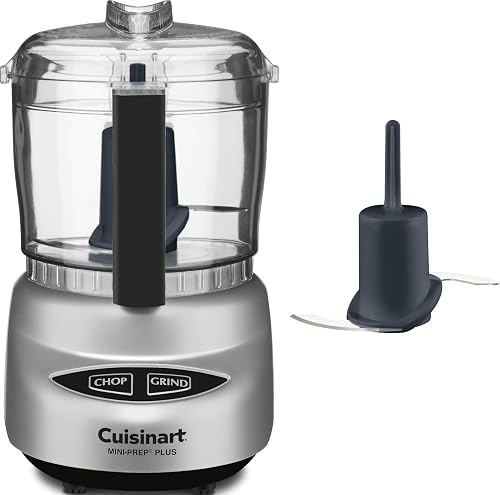
Cuisinart Mini Food Processor 3-Cup: small ingredients and dressings
Cuisinart Mini Food Processor 3-Cup: Best for small prep jobs
- 3-cup work bowl
- 250-watt motor
- Reversible stainless steel blade
- Chop and grind functions
A small bowl suits herbs, dressings and modest amounts of chopped ingredients. Choose it for blade work rather than slicing or shredding.
Pros
- Lightweight at 2.2 lb
- Separate chop and grind controls
- Dishwasher-safe bowl and lid
Cons
- No slicing or shredding discs included
- Cuisinart advises against grinding beans
The Cuisinart Mini Food Processor 3-Cup suits cooks who want help with small, frequent jobs. Think chopped herbs for dinner, breadcrumbs for a topping or a modest batch of pesto.
Its 250-watt motor drives a reversible stainless steel blade with chop and grind controls. The compact body weighs 2.2 lb, making it a practical choice when you plan to put the machine away after use.
For chopped texture, start with brief bursts and check between them. For dressings, the lid's oil holes let you add oil gradually while the ingredients blend.
Choose it as your main prep helper if you rarely need slices or shreds, or as a small companion to a larger machine. Skip it if your main goal is processing vegetables for several meals, since repeated small batches can cancel out the convenience.
Cuisinart advises against grinding beans in this model. If compact size is your priority, our best mini food processors guide covers more small-batch choices.
Cuisinart 11-Cup Food Processor: everyday slicing choices
Cuisinart 11-Cup Food Processor: Best for everyday meal prep
- 11-cup bowl
- Two slicing discs
- Shredding disc
- Chopping/mixing blade
This full-size option suits cooks who want two slicing choices without the largest bowl. It also includes tools for chopping, mixing and shredding.
Pros
- Two slicing discs plus a shredding disc
- Two pusher sizes for the large feed tube
- Dishwasher-safe parts
Cons
- Less batch room than the 14-cup model
- 16.9 lb weight matters for cabinet storage
The Cuisinart 11-Cup Food Processor suits cooks who regularly use slicing discs but don't need the largest bowl here. Its two slicing discs give it a clear reason to choose it over the top pick.
A shredding disc and chopping/mixing blade round out the set. The large feed tube has two pusher sizes, so you can choose the pusher that better supports the food you're feeding through it.
Buy this model if your weekly prep moves between sliced vegetables, shredded ingredients and chopped recipe bases. It makes more sense than a mini chopper when the shape of the finished food matters.
Skip it if you mostly make sauces or chop a little onion. At 16.9 lb and 14.5 in tall, this is still a substantial machine, so moving down in capacity doesn't make it a lightweight cupboard appliance.
Choose it for the slicing options, rather than assuming the smaller bowl alone solves a storage problem. Read our Cuisinart Custom 14-Cup review if you're deciding whether extra batch room would be more useful.
Cuisinart 5-Cup Chop & Shred: compact prep with a disc
Cuisinart 5-Cup Chop & Shred: Best for small kitchens
- 5-cup bowl
- Fine and medium shredding
- Wide-mouth feed tube
- In-bowl parts storage
Choose this compact processor when shredding matters as much as chopping. Parts nest in the bowl, and the base stores the cord.
Pros
- Fine and medium shredding options
- Removable parts nest in the bowl
- Integrated cord storage
Cons
- Limited room for large batches
- One speed
The Cuisinart 5-Cup Chop & Shred fits cooks who need shredding in a smaller setup. It's the clearest middle ground here between a blade-only chopper and a full-size processor.
Its reversible shredding disc offers fine and medium cuts, alongside a universal chopping blade and wide-mouth feed tube. Choose the cut for the recipe: finer shreds blend into mixtures more readily, while larger shreds keep more visible texture.
The removable parts nest in the bowl, and the base stores the cord. That gives you one place to put the machine and its tools instead of finding a separate drawer for loose pieces.
Buy it for modest batches of chopped ingredients and regular shredding when storage is tight. Skip it if you want to process a large recipe in one session without stopping to empty the bowl.
If shredding isn't part of your routine, a simpler chopping setup may be enough. Compare our best food choppers before choosing a disc-equipped machine.
Cuisinart Small 4-Cup Food Processor: small sauces and purées
Cuisinart Small 4-Cup Food Processor: Best for small sauce batches
- 4-cup bowl
- Auto-reversing SmartPower blade
- Chop and grind touchpad controls
- BladeLock system
This chopper suits small sauces, purées and chopped ingredients. BladeLock keeps the blade secure during processing and pouring.
Pros
- Separate chop and grind controls
- BladeLock system for processing and pouring
- Dishwasher-safe removable parts
Cons
- No slicing or shredding discs included
- Small bowl limits batch prep
The Cuisinart Small 4-Cup Food Processor suits small sauces, purées and chopped ingredients when you want more bowl room than the Mini-Prep Plus. Its BladeLock system is the main feature that sets it apart.
The auto-reversing SmartPower blade uses a sharp edge for chopping and puréeing soft foods, and a blunt edge for grinding harder foods. Separate chop and grind touchpad controls let you choose the action for the ingredient.
BladeLock keeps the blade secure during processing and pouring. You still need to handle the sharp edges carefully and follow the manual when removing or cleaning it.
Choose this model if you often transfer a small sauce straight from the bowl and value the blade retention feature. Skip it if you want neat vegetable slices or shredded cheese, since this is a chopper and grinder rather than a disc-equipped processor.
The blade and lid must both lock into position before it will operate. Our food processor size guide can help you decide whether a compact bowl covers your regular recipes.
How much bowl capacity do you actually need?
Choose capacity around your usual batch and the space ingredients need to move. The cup number describes bowl size, not a promise that you can process that amount of every ingredient at once.
Wet mixtures, chopped vegetables and dough each behave differently. Follow the manual's fill limits and recipe guidance rather than filling the bowl to its rim.
Match the bowl to your weekly cooking
For a dressing, herb mixture or small dip, a compact bowl is a sensible starting point. A small amount of food can be harder to process evenly in a large bowl because it may spread away from the blade.
For several meals' worth of vegetables, a larger bowl reduces how often you stop to empty it. That matters most when the processor is handling several ingredients in sequence.
Think through one real meal before buying. If you would need to empty a small bowl repeatedly just to prepare the vegetables, choose more room.
Don't size up only for a celebration you host once a year. A machine that fits your ordinary meals is more likely to get used.
Plan separate batches when texture matters
Even a roomy bowl benefits from separate batches when ingredients need different cuts. Herbs, onions and firm vegetables won't necessarily reach the same texture at the same time.
Process each ingredient to the texture you want, then combine them afterward. This also makes it easier to avoid turning a chopped mixture into a purée.
For disc work, empty the bowl before collected food crowds the underside of the disc. Available collection space matters as much as whether another ingredient fits through the feed tube.
Which blades and discs should drive your choice?
Buy for the finished cut you want, not the number of attachments in the box. Chopping, slicing and shredding are different jobs, and one blade doesn't cover them all.
Our guide to food processor blades and discs explains how each tool changes the result. Use that distinction to cross off models that can't do your main task.
Choose a chopping blade for loose or blended textures
A chopping blade suits rough vegetables, crumbs, dips and mixtures where exact piece shape isn't the goal. Short bursts help you stop at a coarse texture; longer processing moves suitable ingredients toward a smoother mixture.
It won't turn an onion into neat, matching cubes. If precise dice matter for presentation or even cooking, plan to use a knife or a purpose-built tool.
For salsa, chop the firmer ingredients first and check the texture before adding softer ingredients. Running everything together for too long can leave you with more liquid and less distinct texture.
Choose discs for slices and shreds
A slicing disc makes repeated slices as food passes through the feed tube. A shredding disc makes strips, which is why a blade-only mini chopper isn't a substitute for regular grating.
Use the pusher to guide food with steady pressure. Forcing food through can make the task harder to control, while uneven pressure can affect the cut.
Look at whether the included cutting options match your recipes. Fixed sizes are fine for routine prep, but they won't give you every thickness a recipe might request.
Treat dough as a separate buying check
If dough is your main reason to buy, check the model's dough instructions and batch limits before choosing. Bowl volume alone doesn't tell you how much dough it can handle.
The two full-size models support dough preparation, but that doesn't mean every recipe can be scaled to fill the bowl. Dense dough puts different demands on a processor than chopping vegetables.
Use a recipe suited to the machine and avoid extending processing just because a dough hasn't reached the texture you expected. Stop and check it before adding more time.
What should you measure before buying?
Measure the storage spot, working space and room for attachments before ordering. A processor needs more space in use than its base alone suggests.
Check counter depth and width, then look at the clearance below upper cabinets. You need room to remove the lid and handle ingredients, not just slide the assembled machine into place.
For reference, the 14-cup model measures 11 in deep, 7.9 in wide and 14.8 in tall. The Mini-Prep Plus measures 5 in deep, 7 in wide and 9.25 in tall.
The compact Chop & Shred is 13.31 in tall, so a smaller bowl doesn't always mean a low appliance. If height is the tightest limit, measure it separately from footprint.
Choose a storage shelf you can reach comfortably, especially for the full-size machines. A heavy processor at the back of a low cabinet can turn quick prep into a lifting chore.
Allow a safe place for sharp tools to dry and stay protected. Loose discs in a crowded utensil drawer are awkward to retrieve and easy to overlook.
For a broader checklist beyond these Cuisinart models, use our complete food processor buying guide.
How do you set up a Cuisinart food processor for useful results?
Start with correct assembly, evenly cut ingredients and room in the bowl. Those steps give you more control over texture than simply running the machine longer.
Wash the parts as directed before first use and dry them before assembly. Place the base on a dry, level surface and keep it unplugged while fitting or changing sharp attachments.
Follow your model's assembly order for the bowl, blade or disc, lid and pusher. If it won't start, switch it off and check the locks instead of forcing parts into place.
Prepare ingredients for the tool you're using
Cut ingredients into similar pieces before chopping. A large chunk mixed with tiny pieces encourages uneven results because the smaller pieces keep processing while the larger one catches up.
For slicing and shredding, trim food so it fits the feed tube without being forced. Choose the pusher that supports it well and keep fingers out of the tube.
Pat herbs dry before chopping to limit clumping. For shredded cheese, firm, chilled cheese is generally easier to handle than cheese that has softened on the counter.
Stop often enough to control texture
Use short bursts for a coarse chop, checking after each few bursts. You can always process a little more, but you can't restore texture once food becomes too fine.
If food collects on the bowl walls, stop the machine and unplug it before scraping with a spatula. Never reach into the bowl while the processor is connected to power.
Avoid adding extra liquid just to make ingredients move unless the recipe allows it. That can turn a thick dip or filling into something too loose.
Keep hot mixtures out unless your model's instructions allow them and explain the limits. Our guide to using a food processor walks through assembly, controls and common prep tasks.
How do you keep cleanup manageable?
Clean the processor soon after use and according to each part's care instructions. Dried dip, cheese and dough take more work to remove than fresh residue.
Unplug the base and take the machine apart carefully. Handle blades and discs separately, and don't leave them hidden in cloudy dishwater.
The Mini-Prep Plus bowl and lid are dishwasher safe, and the Small 4-Cup has dishwasher-safe removable parts. The full-size models also include dishwasher-safe parts; check the manual for placement and any exceptions.
Wipe the motor base with a damp cloth rather than putting it in water. Check lid grooves, the center of the bowl and the underside of attachments for trapped food.
Dry parts fully before storage, particularly if you're nesting them together. Put sharp pieces away in the arrangement the manual recommends so you can retrieve them safely.
Our dishwasher-safe food processor parts guide helps you check washing instructions. For food stuck around hubs and grooves, see how to clean a food processor.
Which common buying mistakes should you avoid?
Avoid choosing by capacity or wattage alone. The right tools, manageable storage and a bowl suited to your recipes are more useful than a single large number.
- Buying a chopper for shredding: Chop-and-grind controls don't replace a shredding disc.
- Expecting neat dice from a chopping blade: Blade chopping creates irregular pieces, so plan around that texture.
- Treating bowl capacity as a fill line: Follow the limits for the ingredient and task.
- Ignoring attachment storage: A base may fit your cabinet while its loose discs have nowhere safe to go.
- Buying for one rare recipe: Let weekly cooking guide the choice, then work around occasional larger jobs.
- Assuming more processing fixes uneven food: Stop, scrape and reduce the batch if needed before the smaller pieces become a paste.
Also consider the whole prep session. A machine saves little effort if you spend longer retrieving, assembling and washing it than the task would take with a knife.
That doesn't make a compact or full-size processor the better choice for everyone. It means the useful choice is the one that removes a repeated job from your routine.
Which is the best Cuisinart food processor for your routine?
Choose the best Cuisinart food processor by your main weekly task. Make that decision before choosing bowl size, and you'll avoid buying extra capacity while missing the tool you need.
Pick the 14-Cup for larger batches that move between chopping, slicing and shredding. Choose the 11-Cup when two slicing options matter more than maximum bowl room.
Pick the Mini Food Processor 3-Cup for small chopped ingredients, dressings and herbs. Choose the Small 4-Cup when you want a little more room for sauces and value BladeLock during pouring.
Choose the 5-Cup Chop & Shred when you need compact storage and regular shredding. It's the practical choice here for someone whose kitchen is small but whose prep needs go beyond blade chopping.
If your preferred Cuisinart still doesn't match the way you cook, read Ninja vs Cuisinart food processors before making the final choice.
Our top 3 picks at a glance
-
1
-
2
-
3
Frequently asked questions
Which Cuisinart food processor is best for most people?
The Cuisinart 14-Cup Food Processor is the strongest all-purpose choice here for cooks who regularly chop, slice and shred larger batches. Choose a smaller model if most jobs involve a handful of herbs or a little sauce.
Match the machine to your weekly prep rather than an occasional holiday meal.
Is the Cuisinart 14-cup processor better than the 11-cup?
The 14-cup model is better for batch room, while the 11-cup model suits cooks who value two slicing options. More capacity doesn't help much if you rarely fill the bowl.
Read the 14-cup review and 11-cup vs 14-cup guide to choose between their tool sets.
Should you choose a 3-cup or 4-cup Cuisinart chopper?
Choose the 3-cup Mini-Prep Plus for modest chopping jobs, herbs and dressings, or the 4-cup model for extra bowl room and BladeLock. Both offer chop and grind controls with reversible blades.
Neither includes slicing or shredding discs, so choose a disc-equipped processor if those tasks drive your purchase.
Are Cuisinart food processor parts dishwasher safe?
Many removable parts on these Cuisinart models are dishwasher safe, but follow the instructions for your exact model and attachment. Keep the motor base out of water, and handle blades separately from other dishes.
Our food processor parts cleaning guide explains how to check care instructions before washing.


