What Do Food Processor Blades and Discs Do?
Food processor blade types serve different jobs: the S-shaped blade chops, mixes, and purees, while slicing and shredding discs make cuts through the feed tube. Choose attachments for your usual recipes, and check compatibility with your exact model.
On this page (10 sections)
- What do food processor blade types do?
- What does the S-shaped chopping blade do?
- What does a slicing disc do?
- What does a shredding disc do?
- What is a reversible disc?
- Do you need a separate dough blade?
- How do you choose attachments before buying?
- How should you set up blades and avoid common mistakes?
- How should you clean and store blades and discs?
- Which food processor blade types should you choose?
Food processor blade types fall into 3 useful groups: chopping blades work inside the bowl, discs slice or shred through the feed tube, and dough blades mix suitable doughs. Choose by the texture you want, then check which attachments your processor supports.
More attachments aren't always more useful. A chopping blade and a slice-shred option cover many everyday meals; extra tools earn their space when they match recipes you make often.
What do food processor blade types do?
The chopping blade repeatedly cuts food in the bowl, while a disc cuts food as you feed it through the chute. That difference explains why one makes chopped onions and the other makes cucumber rounds.
| Attachment | Use it for | Main limit |
|---|---|---|
| S-shaped or multipurpose blade | Chopping, mincing, mixing, pureeing | Won't make uniform slices or cubes |
| Slicing disc | Flat slices for salads, gratins, and other dishes | Thickness depends on the disc |
| Shredding disc | Strips of firm vegetables or suitable cheese | Won't produce slices or dice |
| Dough blade | Mixing or kneading approved dough recipes | Batch and recipe limits still apply |
For basic controls and assembly, see how to use a food processor. For meal ideas that put each attachment to work, explore what you can make in a food processor.
What does the S-shaped chopping blade do?
Use the S-shaped blade for loose pieces, mixtures, and purees. Short pulses keep a chopped texture, while longer processing breaks ingredients down further.
Cut large ingredients into roughly equal chunks before adding them. A whole onion beside small pieces gives the blade uneven work, so some pieces can become mush before others are small enough.
For herbs, start with dry leaves and a dry bowl to reduce clumping. For salsa, pulse briefly and check often; running continuously can turn a chunky mixture into a sauce.
Which food processor blade types make even dice?
A chopping blade makes irregular pieces, not uniform dice. If neat cubes matter, look for a compatible dicing attachment or finish the job with a knife.
A slicing or shredding disc won't substitute for a dicing kit either. Avoid buying a processor on the assumption that every kind of vegetable cutting uses the same tool.
The Cuisinart 14-Cup Food Processor suits cooks who prep larger batches and want separate slicing and shredding discs. Its slicing disc makes fixed 4 mm slices, and its medium shredding disc is also nonadjustable.
Skip it if changing slice thickness is a priority or most of your work is a small dip or handful of herbs. The larger bowl makes more sense when your usual recipes give it enough food to process.
What does a slicing disc do?
A slicing disc makes flat pieces for cucumber salads, potato layers, and similar dishes. Choose one when consistent thickness matters more than chopped texture.
Ingredient position affects the shape of each slice. Feeding a carrot lengthwise produces rounds, while shorter sections arranged differently can produce longer pieces, depending on the chute and manual.
Trim food to fit without forcing it, then apply steady pressure with the pusher. Heavy pressure isn't a way to change slice thickness and can crush softer ingredients.
Fixed discs give you one thickness; adjustable discs offer a range. If thin slaw vegetables and thicker potato slices are both regular jobs, check that range before buying.
What does a shredding disc do?
A shredding disc makes narrow strips, useful for carrots, cabbage, potatoes, and suitable cheese. Choose the shred size for the dish rather than assuming every disc makes the same cut.
Firm, chilled ingredients are generally easier to shred than warm, soft ones. For cheese, start cold and work in manageable pieces; very soft cheese can smear instead of forming separate strands.
Empty the bowl before food piles up against the underside of the disc. For ingredient choices and preparation, read can a food processor shred cheese?.
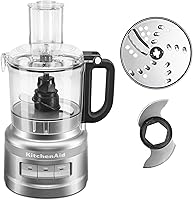
The KitchenAid 7-Cup KFP0718 suits everyday meal prep when you want the attachments stored together. Its multipurpose blade and reversible disc fit inside the bowl, and High, Low, and Pulse controls let you choose between continuous processing and short bursts.
Skip it if you regularly prepare batches that would require repeated emptying, or need several slice thicknesses. Its medium slice-shred disc covers common cuts rather than a range of thickness settings.
What is a reversible disc?
A reversible disc combines 2 cutting functions, often slicing on one side and shredding on the other. It saves a separate attachment, but you must install the correct side for the job.
Stop the machine, wait for all movement to end, and unplug it before changing sides. Follow the manual's markings and handling points rather than touching the cutting surfaces to identify them.
A reversible disc isn't automatically adjustable. Turning it over changes its function, while changing thickness requires a disc specifically designed for that adjustment.
Do you need a separate dough blade?
You need a separate dough blade only when your processor's instructions call for it. Some machines use a metal chopping blade for certain doughs, while others provide a dedicated attachment.
Match the blade to the recipe as well as the machine. Cutting cold fat into flour for pie crust is a different task from kneading an elastic bread dough.
Follow the flour limit and processing time, not just the bowl size. Dough puts a different load on the motor than chopped vegetables, and long runs can warm the mixture.
The Ninja Professional Plus BN601 suits cooks who want dough prep alongside vegetable work. It has a 9-cup bowl, chopping blade, reversible slicing and shredding disc, and 4 Auto-iQ programs for chopping, slicing, pureeing, and dough.
Skip it if you mainly make small chopped portions and won't use the dough attachment or presets. For recipe limits and technique, read can you knead dough in a food processor?.
How do you choose attachments before buying?
Buy for your 3 most common prep jobs, then check capacity, cut size, and storage. A large accessory set adds little value if you only chop vegetables and shred cheese.
Use these questions to narrow the choice:
- Do you need uniform slices? Check the actual thickness or adjustment range.
- Do you grate often? Choose a shred size suited to your usual recipes.
- Will you make dough? Check approved recipes, batch limits, and the required blade.
- Where will sharp parts go? Plan protected storage before adding extra discs.
Buy replacement blades and discs for your exact model number. Similar-looking parts aren't enough to establish compatibility, even within one brand.
For the rest of the machine, how to choose a food processor explains how bowl size, controls, and discs fit together.
How should you set up blades and avoid common mistakes?
Fit attachments with the processor unplugged, following the assembly order for your model. Chopping blades and raised discs can use different supports, so don't assume they mount the same way.
Secure the bowl, attachment, and lid before connecting power. For feed-tube work, prepare pieces that fit easily and keep the pusher ready.
These habits prevent common prep problems:
- Don't overfill. Leave room for ingredients to move around the chopping blade.
- Don't run past the texture you need. Check between pulses when making coarse mixtures.
- Don't force food through the chute. Stop and trim oversized pieces instead.
- Don't reach toward moving parts. Use the pusher and wait for a complete stop before opening.
- Don't scrape around an installed blade carelessly. Unplug first and follow the manual's removal steps.
Avoid treating the full bowl capacity as a liquid fill limit. Use the machine's marked limit or manual guidance for sauces and other wet mixtures.
How should you clean and store blades and discs?
Clean attachments soon after use, before food dries around cutting edges and mounting points. Unplug the base and remove parts using their designated handling points.
Keep blades visible during washing rather than dropping them into cloudy dishwater. Use a brush to reach around sharp areas, then rinse and dry fully.
Dishwasher care depends on the exact part and model, including rack placement. Check whether food processor parts are dishwasher safe before loading them.
Store sharp parts in protective holders or an approved bowl storage system. For a full cleanup routine, see how to clean a food processor.
Which food processor blade types should you choose?
Choose Cuisinart for larger batches with fixed cuts, KitchenAid for everyday prep with in-bowl accessory storage, or Ninja when a dedicated dough attachment and preset programs fit your cooking.
For most kitchens, the useful food processor blade types are a chopping blade and slicing and shredding options. Add specialty attachments when a regular recipe calls for them, and check compatibility before ordering.
Start with the cuts you need, then choose the bowl and storage setup you'll use comfortably. Compare the broader choices in the complete food processor buying guide.
Frequently asked questions
What blade comes with a food processor?
Many food processors include an S-shaped chopping or multipurpose blade, plus a slicing disc, shredding disc, or reversible disc. Some also include a dough blade.
Check the included attachment list for the exact model before buying, especially if you need a particular cut or plan to make dough.
What is the difference between a slicing disc and a shredding disc?
A slicing disc makes flat pieces, while a shredding disc makes narrow strips. Use slices for layered potatoes or cucumber rounds, and shreds for grated cheese or carrots.
A reversible disc can offer both functions, but you must stop and unplug the processor before changing sides.
Can you use a food processor blade for dough?
Yes, if your processor supports dough and you use its recommended attachment. Some recipes use a metal chopping blade, while others call for a separate dough blade.
Follow the model's flour limit and processing time, since a bowl's full capacity is not its safe dough capacity.
How do you store food processor blades safely?
Store blades and discs in a protective holder or an approved bowl storage system, with cutting edges shielded from accidental contact. Dry every part first, and keep loose utensils away from sharp attachments.
Use designated handling points when removing a blade, rather than reaching across its cutting edges.