Cuisinart vs KitchenAid Food Processors: Which Is Better? (November 2026)
For Cuisinart food processor vs KitchenAid, choose Cuisinart for large batches with simple controls. Choose KitchenAid's 7-cup model for smaller meals or its 13-cup model for adjustable slicing and organized accessory storage.
On this page (9 sections)
- Cuisinart food processor vs KitchenAid: what matters most?
- Which bowl size fits the meals you cook?
- Which model should you buy, and who should skip it?
- Which blades and discs will you actually use?
- How do you set up and feed these processors?
- Will it fit your counter and storage space?
- How should you clean and care for each model?
- What mistakes should you avoid with either brand?
- Cuisinart vs KitchenAid: make the final choice
Choose Cuisinart for large batches with simple controls, KitchenAid's smaller model for everyday meals, or its larger model for adjustable slicing. This Cuisinart food processor vs KitchenAid comparison comes down to your usual batch, how you cut vegetables and where the machine will live.
All 3 models chop, slice, shred and puree, so start with a meal you actually cook. A bowl of salsa, vegetables for several dinners and thin slices for a gratin place different demands on the same appliance.

Cuisinart food processor vs KitchenAid: what matters most?
Batch size and slicing control separate these models more clearly than brand name. The Cuisinart suits bulk prep, while the 2 KitchenAid options address smaller portions and more flexible slicing.
The Cuisinart has a 14-cup bowl, the smaller KitchenAid holds 7 cups and the larger KitchenAid holds 13 cups. The difference between the larger pair is modest; the smaller bowl represents a much bigger change in how you divide recipes.
Cuisinart uses on and off/pulse buttons. The KitchenAid KFP0718 offers high, low and pulse, and the KFP1318 also has 3 speeds.
Extra settings are useful if you want more choices while processing, but pulse technique still matters. Short bursts let you stop coarse chopping before it turns into a paste.
| Product | Best for | Capacity | Controls | Feed tube | Our score |
|---|---|---|---|---|---|
| Cuisinart 14-Cup Food Processor | weekly batch prep | 14 cups | On and off/pulse | Extra-large with small and large pushers | 9.2 |
| KitchenAid 7-Cup KFP0718 | smaller everyday meals | 7 cups | High, low and pulse | 2-in-1 | 8.2 |
| KitchenAid 13-Cup KFP1318 | varied vegetable prep | 13 cups | 3 speeds | 3-in-1 | 7.9 |
Which bowl size fits the meals you cook?
Choose a larger bowl for repeated bulk prep and a smaller one for modest recipes. Count how often you'd need to empty the bowl during your normal cooking, rather than choosing the largest capacity available.
For weekly meal prep, consider the whole task: shredding cabbage, chopping vegetables for sauce and preparing a dip. Several foods can use the same bowl in sequence, even when they don't belong in one recipe.
A smaller machine makes sense when you usually prepare ingredients for one meal. If you only occasionally cook for a crowd, splitting that rare large recipe may be easier than storing a larger appliance all year.
Bowl capacity isn't a liquid or dough limit. Ingredients need room to move, and the safe amount depends on the food and the instructions for that model.
Also consider your smallest regular job. A spoonful of herbs or a little garlic may need scraping or a knife because the blade needs enough food around it to cut effectively.
Use our food processor size guide to match capacity to your routine. Our Cuisinart 11-cup vs 14-cup comparison explores another size choice within that brand.
Which model should you buy, and who should skip it?
Buy for the task you repeat most often, then check the trade-off you're accepting. Each model has a clear buyer, and none needs to be the right choice for every kitchen.
Cuisinart food processor vs KitchenAid for batch cooks
The Cuisinart DFP-14BCNY suits cooks who prepare several meals at once and want straightforward controls. It supports vegetable prep, dips, sauces and kneading, making it a useful choice when one machine handles several parts of a cooking session.
Its 720-watt motor is a concrete specification, but use the supported tasks and recipe limits to guide your choice. A wattage figure doesn't tell you how much dough to load or how long to run a recipe.
Choose it if you tend to leave the processor ready on the counter and want to move through a series of substantial jobs. Cuisinart backs the unit with a limited 3-year warranty and the motor with a full 5-year warranty.
Skip it if you mainly chop tiny amounts, need to lift the machine frequently or want to change slice thickness. Its strengths won't solve those needs.
KitchenAid 7-Cup KFP0718 for everyday meals
The KFP0718 suits smaller recipes and cooks who put the processor away after use. Its lighter build and in-bowl accessory storage make sense when getting the machine out is part of every cooking session.
The twist-free, one-click bowl assembly and latched lid also suit buyers who want a clear setup routine. Its core tools cover chopped vegetables, salsa, sauces and cheese prep without a large collection of separate accessories.
Choose it when most of your work is for the next meal rather than a full week. Keeping the tool set modest can also make it easier to find the right attachment quickly.
Skip it if you regularly process large quantities or want fine control over slice thickness. Repeatedly emptying the bowl can interrupt the very task you're buying a processor to shorten.
KitchenAid 13-Cup KFP1318 for varied prep
The KFP1318 suits cooks who prepare vegetables in different thicknesses and want a large bowl with organized accessories. Choose it over the Cuisinart when changing the cut matters more than the small capacity difference.
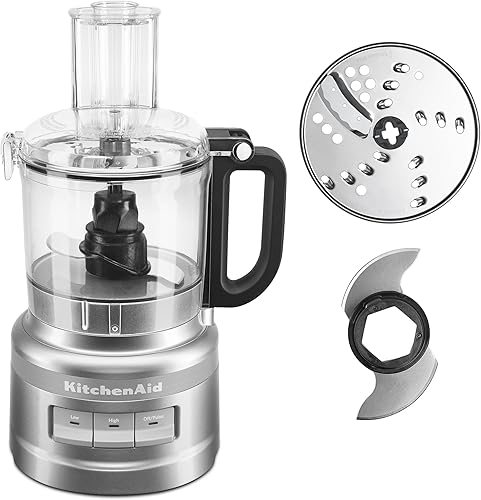
It includes a multipurpose blade, adjustable slicing disc, reversible shredding disc and dough blade. The storage caddy keeps those tools together inside the bowl between cooking sessions.
This is the stronger fit for a cook who alternates among sliced potatoes, shredded vegetables and dough recipes. You get more ways to prepare ingredients without making fixed slicing thickness part of every meal.
Skip it if you'll mostly chop onions or make the same dip. The added tools need a purpose, and its taller body needs a suitable storage spot.
For other choices within the brand, explore our best Cuisinart food processors. Our Ninja vs Cuisinart comparison helps if you're still comparing brands.
Which blades and discs will you actually use?
Choose the chopping blade for food that stays in the bowl and a disc for food fed through the lid. The attachment determines the cut, so decide what you want before loading ingredients.
The Cuisinart includes a chopping/mixing blade, a fixed 4mm slicing disc and a medium shredding disc. Its slicing and shredding blades aren't adjustable, making it a better fit when those cuts already suit your recipes.
The smaller KitchenAid includes a multipurpose blade and one reversible medium slicing/shredding disc. You change tasks by using the correct side of the disc, rather than choosing between separate slicing and shredding pieces.
The larger KitchenAid's externally adjustable Exact Slice disc changes from thick to thin. That matters if you want different cuts for salads, layered dishes and cooked vegetables, rather than one standard slice.
A slicing disc doesn't make cubes. For recipes that need evenly diced vegetables, don't assume a processor's general chopping function will produce the same result as a dedicated dicing attachment.
Dough needs its own recipe and loading limits, even with a suitable blade. For help identifying each tool, read our guide to food processor blades and discs.
How do you set up and feed these processors?
Assemble the bowl and attachment before adding food, following the model's manual. Check that the lid and bowl are properly secured before starting.
Both KitchenAid models use a twist-free bowl assembly and latched lid. Read the Cuisinart's setup instructions carefully, including how the bowl sleeve, pushers and detachable disc stem fit together.
Cuisinart provides an extra-large feed tube with small and large pushers. KitchenAid uses a 2-in-1 tube on the smaller model and a 3-in-1 tube on the larger one.
Pick the opening that supports the ingredient without crowding it. A narrow carrot benefits from support that keeps it upright; a wider piece of produce may need trimming before it fits safely.
Use the food pusher, never your fingers or a utensil, to move ingredients through the tube. Feed with steady pressure rather than forcing a large piece against the disc.
For chopping, cut ingredients into roughly similar pieces before loading. Mixing a large chunk of carrot with small onion pieces encourages uneven results because the smaller pieces finish first.
Start with short pulses, inspect the texture and scrape down only after stopping and unplugging the machine. Our food processor use guide explains the basic sequence in more detail.
Will it fit your counter and storage space?
Measure the appliance and its access space, especially if it will sit under cabinets. A machine that fits while closed still needs room for loading and removing parts.
| Model | Depth × width × height | Weight |
|---|---|---|
| Cuisinart DFP-14BCNY | 11 × 7.9 × 14.8 in | 18 lb |
| KitchenAid KFP0718 | 7.87 × 9.65 × 15.35 in | 6.6 lb |
| KitchenAid KFP1318 | 8.75 × 10.25 × 17.44 in | 9.7 lb |
The smaller KitchenAid bowl doesn't mean the machine is shortest or narrowest in every direction. Compare the actual shape with your shelf, not just its cup capacity.
Leave room to lift off the lid, remove the bowl and reach the outlet. For cabinet storage, check whether you can lift the appliance comfortably without tilting it around a shelf edge.
Both KitchenAid models keep accessories inside the bowl; the larger model uses its caddy. Keep sharp edges secured as the manual directs, and remove stored tools before loading food.
The Cuisinart's weight makes its storage location worth deciding before you buy. A permanent counter spot may suit it better than a deep cabinet that requires frequent lifting.
How should you clean and care for each model?
Clean soon after prep and follow the care instructions for each part. Dried dough, cheese and puree take more effort to remove from seams and blade fittings.
Unplug the base, then lift out sharp attachments carefully by their safe handling points. Don't leave a blade loose in cloudy dishwater where someone could reach for it.
KitchenAid describes a bowl-cleaning method using warm water and 1 or 2 drops of dish soap in its leak-resistant bowls. Follow the manual's operating steps and rinse afterward; inspect crevices for food that still needs attention.
The Cuisinart has dishwasher-safe parts and a detachable disc stem. Separate removable pieces as directed so food doesn't remain trapped around their connections.
Keep the motor base out of water. Wipe it with a damp cloth and dry removable parts fully before putting the appliance away.
Dishwasher instructions can differ by component, so check rack placement and any hand-wash requirements. Our guide to dishwasher-safe food processor parts explains what to check before loading.
What mistakes should you avoid with either brand?
Avoid overfilling, overprocessing and choosing the wrong attachment. Good results depend on matching the method to the food, even after you've chosen the right machine.
- Don't run continuously for every task. Pulse coarse mixtures and stop to inspect them before the texture gets finer than you want.
- Don't combine foods with very different prep needs. Chop firm vegetables separately from soft ingredients when they need different processing times.
- Don't pack the feed tube tightly. Trim food to fit and leave it able to move under the pusher.
- Don't treat hot soup like a cold dip. Follow the manual's temperature and liquid limits before pureeing.
- Don't improvise large dough batches. Follow a recipe suited to the processor and stop if the machine struggles.
- Don't expect the processor to replace every knife cut. Delicate garnishes and small amounts can still be quicker by hand.
Plan the order of a multi-step recipe, too. Shred cheese before making a wet sauce when practical, then clean between foods whenever needed for food safety.
Cuisinart vs KitchenAid: make the final choice
Choose Cuisinart for repeated bulk prep, the smaller KitchenAid for everyday portions, or the larger KitchenAid when adjustable slicing earns its place in your kitchen. Make the Cuisinart food processor vs KitchenAid decision around the job you'll do next week.
Write down your 3 most common tasks and where the machine will stay. If those answers point to big batches and a counter spot, choose Cuisinart; if they point to smaller meals and cabinet storage, choose the KFP0718.
Choose the KFP1318 when you want a larger machine and regularly change how thickly you slice vegetables. That feature is a stronger reason to pick it than buying extra capacity you rarely use.
If you're still deciding what a processor should handle, start with our complete food processor buying guide. For a wider shortlist, see our best food processors guide.
Frequently asked questions
Is Cuisinart or KitchenAid better for a food processor?
Choose Cuisinart for large batches with simple controls, or KitchenAid for smaller everyday prep or adjustable slicing. The KitchenAid models serve different needs: the smaller model suits dinner prep, while the larger one suits cooks who want varied slice thickness.
Choose the model around your usual recipes.
Which food processor has more capacity?
The Cuisinart has the largest bowl at 14 cups, followed by the KitchenAid KFP1318 at 13 cups and KFP0718 at 7 cups. These are bowl capacities, not universal recipe limits.
Follow the manual's limits for liquids and dough rather than filling any bowl to its rim.
Can the KitchenAid 13-cup processor adjust slicing thickness?
Yes, the KitchenAid KFP1318 has an externally adjustable Exact Slice disc that changes slice thickness from thick to thin. That suits cooks preparing different vegetable dishes throughout the week.
The Cuisinart and smaller KitchenAid include fixed slicing discs, so choose the larger KitchenAid if thickness changes are a priority.
Which is easier to store, Cuisinart or KitchenAid?
KitchenAid makes accessory storage simpler because both models keep blades and discs inside their bowls. The larger model includes a storage caddy.
Appliance fit is a separate question: measure cabinet height, shelf depth and the space needed to lift the machine out before choosing a permanent storage spot.
Which Cuisinart or KitchenAid food processor is easier to clean?
KitchenAid offers a bowl-cleaning method using warm water and 1 or 2 drops of dish soap, while Cuisinart includes dishwasher-safe parts and a detachable disc stem. Choose around your washing routine, then follow the manual for each component.
Always unplug the processor before removing blades or washing parts.