5 Best Food Choppers (November 2026)
The best food choppers include the Hamilton Beach 3-Cup Chopper for everyday prep, the BLACK+DECKER 1.5-Cup Chopper for tiny batches, and the KitchenAid 3.5-Cup Food Chopper for varied textures.
On this page (7 sections)
- How we chose the best food choppers
- Best food choppers for different kitchen tasks
- What should you compare before buying a food chopper?
- How do you set up a food chopper for even results?
- Which common mistakes make a food chopper less useful?
- How should you clean and store a food chopper?
- Which food chopper should you choose?
The best food chopper for everyday prep is the Hamilton Beach 3-Cup Chopper, with simple stack-and-press assembly and enough bowl space for small meal-prep jobs.
Choose the BLACK+DECKER 1.5-Cup Chopper for tiny portions, or the KitchenAid 3.5-Cup Food Chopper if you often switch between chunky and smooth mixtures.
Start with what you actually chop each week. A machine for parsley and breadcrumbs has a different job from one used for vegetable prep and dips.
If you regularly need large batches, slices or shredded ingredients, read our food chopper vs food processor comparison before choosing.
Our picks at a glance
-
1

-
2

-
3

- 4
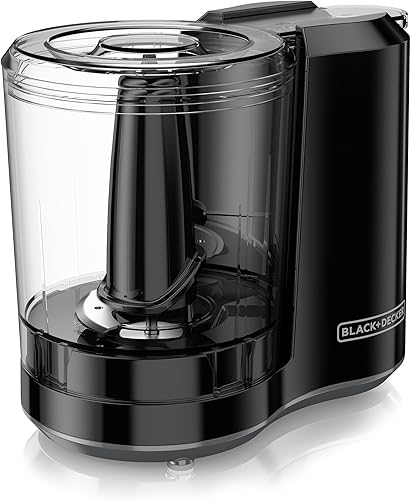 Best for simple dip prepCheck it
- 5
 Check it
Cuisinart Core Custom 4-Cup Mini Chopper
Best for chopping and grinding
How we chose the best food choppers
We compared batch size, controls, assembly and cleanup to find a useful match for different small prep jobs. Liquid-addition features and the way each bowl empties also matter for cooks who make sauces.
The highest-ranked choice balances everyday capacity with simple operation. The other picks suit narrower needs, such as very small portions, more texture settings or a separate grinding function.
Motor wattage is useful context, but it does not tell you which machine produces the most even chop. Food size, bowl loading and how you use the controls also affect the result.
These are electric blade choppers for chopping, mixing and related small-batch work. None of these picks includes a slicing disc, shredding disc or dicing grid.
| Product | Best for | Capacity | Controls | Cleanup | Our score |
|---|---|---|---|---|---|
| Hamilton Beach 3-Cup Chopper | everyday prep | 3 cups | Press lid to chop, release to stop | Bowl, lid and removable blades are dishwasher safe | 8.5 |
| BLACK+DECKER 1.5-Cup Chopper | tiny batches | 1.5 cups | One-touch pulse | Removable parts are dishwasher safe | 8.2 |
| KitchenAid 3.5-Cup Food Chopper | varied textures | 3.5 cups | Two speeds and pulse | Work bowl is dishwasher safe | 7.8 |
| BLACK+DECKER 3-Cup Chopper | simple dip prep | 3 cups | One-touch pulse | Removable parts are dishwasher safe | 7.7 |
| Cuisinart Core Custom 4-Cup Mini Chopper | chopping and grinding | 4 cups | Paddle controls for chop and grind | Dishwasher-safe parts and lid; follow the manual for each part | 7.2 |
Best food choppers for different kitchen tasks
Choose Hamilton Beach for general prep, BLACK+DECKER's smaller model for modest portions, and KitchenAid for more texture settings. The larger BLACK+DECKER keeps dip prep simple, while Cuisinart adds distinct chop and grind controls.
Hamilton Beach 3-Cup Chopper: Best for everyday prep
- 3-cup bowl
- Stack-and-press design
- 350-watt motor
- Dishwasher-safe bowl, lid and blades
Choose this for regular onion, herb and dip prep without twist-lock assembly. Its lid dispenser also lets you add oil gradually for dressings.
Pros
- Lid stacks without twist-lock assembly
- Oil dispenser for dressings and sauces
- Dishwasher-safe bowl, lid and removable blades
Cons
- One speed
- Large recipes need separate batches
The Hamilton Beach 3-Cup Chopper is the most useful starting point if your usual jobs include onions for dinner, chopped herbs or a small sauce. Its stack-and-press assembly avoids a twist-locking step: stack the lid, press to run and release to stop.
That setup suits someone who wants to take a chopper out for a short task without working through several controls. You still need to watch the food and release the lid before a coarse chop becomes a puree.
The 350-watt motor and stainless steel blades support chopping, mincing, pureeing and emulsifying. Use the lid's oil dispenser when a dressing calls for oil to be added gradually.
This is a practical choice if your prep varies from day to day and you want one bowl for several small jobs. It also keeps care straightforward, with a dishwasher-safe bowl, lid and removable blades.
Skip it if you want separate speed settings or routinely prepare enough food to require several loads. For broader capacity and attachment options, see our best food processors guide.
BLACK+DECKER 1.5-Cup Chopper: Best for tiny batches
- 1.5-cup bowl
- One-touch pulse control
- 150-watt motor
- Dishwasher-safe removable parts
The smallest bowl here suits herbs, breadcrumbs and small recipe add-ins. Choose it when modest portions matter more than room for a full dip recipe.
Pros
- Small bowl for modest prep jobs
- Oil holes for adding oil during mixing
- Lightweight at 1.2 pounds
Cons
- Larger recipes require more batches
- One speed
The BLACK+DECKER 1.5-Cup Chopper fits cooks who need a small amount of an ingredient rather than a bowlful of food. Think herbs for a sauce, breadcrumbs for a topping or chopped chocolate for a recipe.
Its small bowl and one-touch pulse control make sense for these short jobs. A 150-watt motor drives the bi-level stainless steel blade, and oil holes allow oil to be added during mixing.
Choose this model if a larger appliance would mostly sit unused because your portions are modest. It can also serve a clear role beside a larger machine: small add-ins go here, while bulk prep goes in the larger bowl.
Do not choose it just because you cook for 1 person. A single serving of a vegetable-heavy meal can still involve more prep than a tiny bowl comfortably holds.
Skip it for regular dip batches or bulk vegetable prep, unless you are happy to work in several loads. Our best mini food processors guide covers other choices when you want a small appliance with more bowl room.
KitchenAid 3.5-Cup Food Chopper: Best for varied textures
- 3.5-cup work bowl
- Two speeds plus pulse
- Handle and pour spout
- Drizzle basin
Two speeds and pulse suit cooks who switch between chunky salsa and smooth sauces. A handle, pour spout and locking blade help with transferring the finished mixture.
Pros
- Two speeds plus pulse
- Handle, pour spout and locking blade
- Cord wrap for storage
Cons
- Wider and taller than the smallest pick
- Less capacity than the Cuisinart
The KitchenAid 3.5-Cup Food Chopper suits cooks who make both coarse mixtures and smooth sauces. Its 2 speeds plus pulse give you more ways to approach texture than the single-speed models here.
Choose it for a routine that includes chunky pico de gallo one day and a smooth dressing the next. The settings give you options, though stopping to inspect the mixture still matters more than running it for a fixed time.
The handled work bowl has a pour spout, and the multipurpose blade locks in place for pouring. Those details are useful when moving a finished sauce into a serving jug or adding a puree to another dish.
A drizzle basin supports gradual liquid addition, while the cord wrap helps keep the appliance together in storage. The work bowl is dishwasher safe; follow the manual for the other pieces.
Skip it if you only need occasional rough chopping and would rather have simpler controls. If your priority is the shape of chopped vegetables, compare the different approaches in our best vegetable choppers roundup.
BLACK+DECKER 3-Cup Chopper: Best for simple dip prep
- 3-cup bowl
- One-touch pulse control
- 175-watt motor
- Oil holes in cover
This model suits small dips, breadcrumbs and chopped ingredients with one-touch pulse control. Cover holes let you slowly add oil for hummus or vinaigrette.
Pros
- Bowl suits small dips and meal ingredients
- Oil holes in the cover
- Dishwasher-safe removable parts
Cons
- One speed
- No separate chop and grind controls
The BLACK+DECKER 3-Cup Chopper suits cooks who want one-touch pulse control for small dips and everyday ingredients. Its oil holes in the cover let you add oil slowly while making hummus or vinaigrette.
It also supports jobs such as breadcrumbs and salsa, so it can cover several recipe steps without requiring separate speed choices. The 175-watt motor works with a bi-level stainless steel blade.
This is a sensible alternative to the smaller BLACK+DECKER when you like the same basic control approach but need more bowl room. That extra space is useful when a recipe combines chopped solids with other ingredients.
Compared with Hamilton Beach, the choice is mainly about how you prefer to assemble and operate the appliance. Hamilton Beach leads this roundup because its stack-and-press design makes assembly especially straightforward.
Skip this model if separate speeds or a dedicated grind control are on your must-have list. For a coarse dip, use brief pulses and check early rather than relying on a long run to finish the whole batch.
Cuisinart Core Custom 4-Cup Mini Chopper: Best for chopping and grinding
- 4-cup work bowl with handle
- Chop and grind paddle controls
- Auto-reversing stainless steel blade
- BladeLock system
Choose this for the largest bowl in the group and separate chop and grind functions. The handled bowl and BladeLock system help when pouring out finished ingredients.
Pros
- Largest bowl in this group
- Separate chop and grind controls
- Blade stays secured for pouring
Cons
- Heaviest pick here at 3.7 pounds
- Deepest footprint in this group
The Cuisinart Core Custom 4-Cup Mini Chopper suits cooks who want more bowl room and expect to grind as well as chop. Its separate paddle controls work with an auto-reversing stainless steel blade.
That combination gives it a different role from a basic pulse-only chopper. Cuisinart includes uses such as chopping vegetables, grinding spices, pureeing applesauce and emulsifying salad dressing.
The handled bowl and BladeLock system help when pouring out finished food. A spatula is included for moving mixtures out of the bowl, though you should still unplug the appliance before reaching inside.
Choose it when those functions address recurring recipe steps. If your spice work needs a very fine powder, check the manual's supported ingredients and directions rather than assuming every grinding task is suitable.
Skip it if you mainly chop tiny garnishes or need the easiest model to lift from a low cabinet. It is the heaviest pick here at 3.7 pounds and the deepest at 9.29 inches, so measure the intended storage space.
What should you compare before buying a food chopper?
Choose by your usual batch, desired texture and cleanup routine before comparing extra features. A chopper earns its space when it fits a task you repeat often enough to make setup worthwhile.
What size is the best food chopper for your meals?
The right bowl holds your normal prep batch without crowding the blade. Choose around the ingredients you prepare together, rather than the number of people in your home alone.
For example, a garnish needs little room, while a dip needs space for both its solids and its liquid ingredients. A vegetable base for several meals can quickly turn a small chopper into a repeated loading job.
The stated cup capacity describes bowl size, not permission to fill every recipe to the rim. Follow the manual's limits for the food you are preparing, especially liquids.
A larger bowl is not automatically better for a few leaves or cloves, either. Very small amounts can be harder to keep near the blade in a bowl with lots of empty space.
If repeated batches are already part of your routine, our food processor buying guide explains what larger bowls and attachments add.
Which controls match the texture you want?
Pulse control is the main tool for keeping chopped food coarse. Short bursts give you chances to inspect the mixture before small pieces become paste.
Speed choices help when your recipes vary, but they do not remove the need to stop at the right point. A chunky salsa and a smooth sauce need different approaches even if they start with similar ingredients.
A separate grinding function is worth considering when recipes regularly call for it. Choose the Cuisinart for that specific need rather than buying extra controls you rarely expect to use.
Will you make more chopped ingredients or pourable mixtures?
For chopped ingredients, focus on loading, pulse control and access for scraping out the bowl. For dressings and sauces, also consider how you will add liquids and transfer the finished mixture.
An oil dispenser, oil holes or a drizzle basin can support gradual addition while the bowl stays covered. These features do not mean you can add unlimited liquid.
A handle and pour spout can be helpful when a sauce needs to go into a narrow container. If you usually scrape chopped onions straight into a pan, pouring features may matter less.
Does the appliance fit where you will use it?
Measure the shelf, cabinet opening and counter space before choosing. Leave enough room to remove the lid and bowl without moving other appliances.
Also think about the route from storage to the outlet. A model that is awkward to retrieve may stay in the cabinet even when it would help.
Keep the cord away from hot surfaces and the counter edge. Choose a stable work area where you can operate the controls without stretching across the appliance.
How do you set up a food chopper for even results?
Start with proper assembly and evenly sized pieces so the blade can reach the food without working around large chunks. Wash the approved removable parts before first use and follow the manual's assembly order.
Prepare the ingredients before loading
Remove pits, hard shells, bones and other parts that do not belong in the finished food. Peel or trim ingredients as the recipe requires.
Cut large vegetables into similar chunks that fit comfortably in the bowl. Putting a large piece beside several tiny pieces makes it harder to finish them at the same texture.
Drain wet ingredients when excess liquid would spoil the recipe. Dry herbs after washing if you want a loose chop rather than a wet clump.
Do not assume the chopper can handle ice, frozen blocks or every hard ingredient. Use only foods and preparation methods approved for that model.
Load in batches when necessary
Leave room for ingredients to move rather than pressing them tightly around the blade. If the bowl is crowded, divide the food before starting.
For a recipe with ingredients of different firmness, chop them separately when practical. Combine them afterward so a soft ingredient does not turn to puree while a firmer one remains chunky.
If you are making several batches, aim for similar amounts in each load. Mix the finished batches together before judging the overall texture or adding final seasoning.
Pulse, inspect and scrape safely
Begin with brief pulses for chopped food, then pause to check the result. It is easier to make the pieces smaller than to repair an overprocessed mixture.
If food sticks to the sides, release the control, wait for the blade to stop and unplug the appliance. Remove the lid and use a suitable spatula to move food back toward the center.
Keep fingers and utensils out while the blade is moving. Reassemble the bowl correctly before reconnecting power and continuing.
For a smooth dip, scrape-down pauses can help bring unmixed food back into the mixture. Add recipe liquids gradually within the appliance's limits rather than flooding the bowl to force circulation.
Which common mistakes make a food chopper less useful?
The main mistakes are overfilling, running too long and expecting uniform dice from a rotating blade. Correcting those habits often matters more than choosing another control setting.
Expecting neat cubes from a blade chopper
A rotating blade cuts pieces as they move through the bowl, so their shapes will vary. It is useful for chopped ingredients, but it does not create the same result as pushing food through a dicing grid.
If evenly shaped cubes are essential to the recipe or presentation, use a knife or an appliance designed for that cut. Our guide to food processor blades and discs explains how different cutting tools change the result.
Trying to save time with one long run
A long run can turn onions watery or take a chunky dip past the texture you wanted. Start cautiously and stop as soon as the food is suitable for the recipe.
If some pieces stay large while others become very fine, stop and redistribute the food safely. More running time alone may only make the smallest pieces finer.
Using a chopper for every prep task
A knife can be quicker for a single garnish once you include assembly and washing. Save the appliance for jobs where the amount, texture or repeated chopping makes it worthwhile.
These picks also do not replace every function of a larger food processor. If slicing, shredding or dough preparation drives your buying decision, our guide to choosing a food processor covers capacity, power and discs.
Processing hot food without checking the instructions
Do not put hot food into a covered chopper unless the manual permits it. Follow its temperature guidance and let cooked ingredients cool as directed before processing.
A model that can puree cooked vegetables is not automatically suitable for handling them straight from a hot pan. Plan the cooling step before starting a sauce or puree.
How should you clean and store a food chopper?
Unplug, separate and clean the approved parts promptly so food does not dry around the blade or lid. Keep the electric base out of water and follow the manual for each removable piece.
Clean the blade without hiding it in the sink
Handle the blade by its designated hub and keep your fingers away from the edges. Do not leave it loose under cloudy dishwater where someone could reach onto it.
Use a brush when needed to reach around food caught near the blade. Avoid wiping along a cutting edge with your fingers or trying to pull trapped food free while the blade is installed.
Our guide to cleaning a food processor covers similar bowl and blade care.
Check the dishwasher directions part by part
Dishwasher-safe parts do not make the whole appliance dishwasher safe. Check which pieces are approved and where the manual says to place them.
Food can collect around lid openings and the blade hub, so inspect those areas after cleaning. A dishwasher cycle does not replace checking that all residue is gone.
For more detail on materials and care directions, read which food processor parts can go in the dishwasher.
Store everything dry and with the blade protected
Let the bowl, lid and blade dry fully before putting them away. Store sharp parts as directed so the edge is protected and easy to identify when you next assemble the appliance.
Wipe the base with a damp cloth and dry it before storage. Keep all parts together so a missing lid or blade does not hold up the next meal.
Which food chopper should you choose?
The best food chopper for your kitchen is the one that fits your most common job without creating extra batches or unnecessary setup. Use the task you repeat each week to make the final choice.
- Choose Hamilton Beach for general ingredient prep and simple stack-and-press assembly.
- Choose BLACK+DECKER 1.5-Cup for small add-ins when a larger bowl would be unnecessary.
- Choose KitchenAid if switching between chunky mixtures and smooth sauces makes extra texture controls useful.
- Choose BLACK+DECKER 3-Cup for straightforward dip and ingredient prep with one-touch pulse control.
- Choose Cuisinart Core Custom when separate chopping and grinding functions justify its larger bowl and storage footprint.
If none can hold your usual batch comfortably, move up in capacity. Compare the best food processors before buying a small chopper that would leave you repeating the same task several times.
Our top 3 picks at a glance
-
1
-
2
-
3
Frequently asked questions
What size food chopper should I buy?
Choose a bowl that fits your usual prep task with room for food to move. A 1.5-cup model suits small add-ins, while 3 to 4 cups gives you more room for vegetables and dips.
Follow the manual's food and liquid limits, since bowl capacity is not a universal working limit.
Can a food chopper make sauces and dressings?
Yes, these models include options for sauces, dressings or similar mixtures. Hamilton Beach has an oil dispenser, KitchenAid has a drizzle basin, and both BLACK+DECKER models have oil holes.
Cuisinart supports emulsifying salad dressing.
Add liquids as directed and stay within the manual's liquid limit to reduce leaks and splashes.
Are food chopper parts dishwasher safe?
Yes, these models include dishwasher-safe removable parts, but the approved pieces vary. Hamilton Beach specifies the bowl, lid and removable blades; KitchenAid specifies the work bowl.
Follow each manual for blade care and rack placement.
Keep electric bases out of the dishwasher and wipe them clean with the appliance unplugged.
Should I choose a food chopper or food processor?
Choose a food chopper for small batches of chopped ingredients, dips and sauces. Choose a larger food processor when repeated batches slow you down or you need slicing and shredding attachments.
Check which attachments come with the machine, since a larger bowl alone does not add those functions.


