6 Best Food Processors (November 2026)
The best food processors include the Cuisinart 14-Cup Food Processor for batch cooks, the Ninja Professional Plus BN601 for guided meal prep, and the Hamilton Beach 70730 10-Cup for dip makers.
On this page (10 sections)
- Which food processor is best for your kitchen?
- How do the food processors compare?
- What capacity should you choose?
- Do you need presets, speed choices or pulse?
- Which attachments will you actually use?
- How much counter and storage space do you need?
- How should you set up and use a food processor?
- Which food processor is easiest to clean?
- What mistakes should you avoid?
- Which best food processor should you buy?
The best food processor for regular batch cooking is the Cuisinart 14-Cup Food Processor, with room for larger recipes and tools for slicing, shredding and chopping. Choose the Ninja Professional Plus BN601 for guided prep, or the KitchenAid 7-Cup KFP0718 for smaller daily batches.
Buy for the meals you make each week. A large bowl helps with a pile of vegetables, but a smaller machine may be the better choice if it is easier to store and bring out.
Start with our complete food processor buying guide if you're still deciding whether you need one. For help matching bowl size to your recipes, see what size food processor you need.
Our picks at a glance
-
1

-
2

-
3

- 4
 Best for smaller householdsCheck it
- 5
 Check it
Cuisinart 11-Cup Food Processor
Best for family vegetable prep - 6
 Best for varied vegetable dishesCheck it
Which food processor is best for your kitchen?
Choose the Cuisinart 14-Cup for larger workloads, Ninja for programmed tasks, or the smaller KitchenAid for modest meals. The other picks solve more specific needs, including scraping thick mixtures, choosing between slicing discs and adjusting slice thickness.
We compared bowl size, controls, attachments and storage needs. The product write-ups below explain the tradeoff behind each recommendation, so you can choose by your cooking habits rather than score alone.
Cuisinart 14-Cup Food Processor: Best for batch cooks
- 14-cup bowl
- 720-watt motor
- 4mm slicing disc and shredding disc
- Chopping and mixing blade
Choose this for regular large-batch prep when fixed slicing thickness suits your recipes. The roomy bowl comes with tools for vegetables, dips and dough.
Pros
- Largest bowl in this group
- Extra-large feed tube with two pusher sizes
- Dishwasher-safe attachments
Cons
- Slicing and shredding blades are not adjustable
- 18 lb weight makes frequent moving less appealing
The Cuisinart 14-Cup Food Processor suits cooks who regularly prepare vegetables, dips or dough for several meals. Its extra-large feed tube and two pusher sizes help with different ingredient shapes, although food still needs trimming to fit safely.
You get a 4mm slicing disc, a medium shredding disc and a chopping/mixing blade. That covers sliced vegetables, grated ingredients and mixtures such as hummus without buying a machine around a long accessory list.
The 720-watt motor uses on and off/pulse controls. Short pulses are useful for chopped vegetables because you can stop before the pieces turn into a wet mixture.
Skip it if you mainly make small portions or want to change slice thickness without changing equipment. Its slicing and shredding blades are fixed, so the larger KitchenAid is the better match for varied slice thicknesses.
This Cuisinart makes most sense as a regular prep tool rather than an occasional gadget stored out of reach. Read our Cuisinart Custom 14-Cup review for a closer look at its features.
Ninja Professional Plus BN601: Best for guided meal prep
- 9-cup bowl
- 1000-peak-watt motor
- Four Auto-iQ programs
- Chopping blade, dough blade and reversible disc
Preset programs suit cooks who want a starting point for common prep tasks. A separate dough blade adds a reason to choose it for pizza and bread recipes.
Pros
- Programs for chopping, slicing, pureeing and dough
- Includes a dough blade
- Removable parts are dishwasher safe
Cons
- Less batch room than the larger picks
- Presets still require checking the food's texture
The Ninja Professional Plus BN601 suits cooks who want a programmed starting point for chopping, slicing, pureeing and dough. Its four Auto-iQ programs reduce the number of control choices you need to make before starting a task.
The 9-cup bowl fits between a small daily-prep machine and the larger batch options here. A chopping blade, separate dough blade and reversible slicing/shredding disc give it a useful mix of tools for family cooking.
Choose it if pizza dough and chopped vegetables both appear in your weekly routine. Follow the dough limits in the manual rather than assuming the bowl can handle the same volume of every ingredient.
Skip it if your main goal is fewer batches when preparing large quantities. A program cannot create more bowl space, and you still need to check texture before running another cycle.
Its 1000-peak-watt figure describes peak power, so it should not be treated as a direct performance ranking against the other motors. Our Ninja Professional Plus review explains the machine's features in more detail.
Hamilton Beach 70730 10-Cup: Best for dip makers
- 10-cup bowl
- Built-in bowl scraper
- 450-watt motor
- Two speeds plus pulse
The built-in scraper suits dips and sauces that collect around the bowl's sides. Manual speed choices let you adjust the pace as the mixture changes.
Pros
- Scraper works with the lid in place
- Two speeds plus pulse
- Large feed chute
Cons
- No separate dough blade included
- Scraper adds another part to clean
The Hamilton Beach 70730 10-Cup is the pick for cooks who often make dips, sauces and other mixtures that gather on the bowl's walls. Its built-in scraper lets you move ingredients back toward the blade without removing the lid.
Hamilton Beach allows the scraper to move from side to side with the processor running or stopped. That permission applies to the built-in scraper, never to a separate spatula or another utensil.
The chopping/pureeing blade and slicing/shredding disc cover common prep jobs. Low, high and pulse controls let you choose a steady pace or work in short bursts when the texture needs closer attention.
Skip it if dough is your main reason for buying. A model with an included dough blade and a clear dough routine is a more direct fit for that need.
The scraper is useful only if you'll use it, and it adds a piece to wash after a recipe. See our Hamilton Beach 70730 review for more on its controls and attachments.
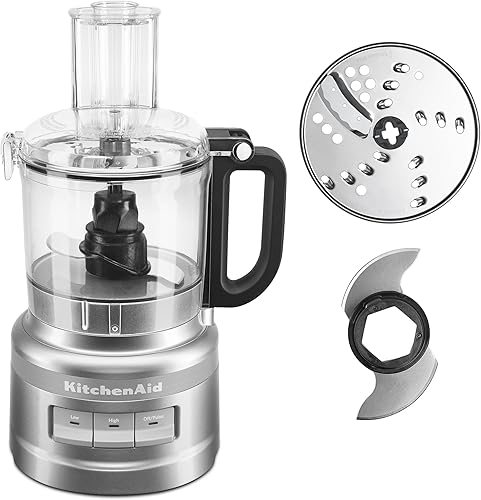
KitchenAid 7-Cup KFP0718: Best for smaller households
- 7-cup bowl
- High, low and pulse controls
- Reversible medium slicing/shredding disc
- In-bowl accessory storage
A practical choice for modest daily recipes when keeping accessories together matters. The twist-free bowl assembly and latched lid simplify setup.
Pros
- Accessories store inside the bowl
- High, low and pulse controls
- One-click bowl assembly
Cons
- Smallest bowl in this group
- Medium slicing disc has no thickness adjustment
The KitchenAid 7-Cup KFP0718 suits smaller households that want to chop vegetables, shred cheese or make a modest batch of sauce. Its accessories store in the bowl, which helps if loose discs tend to get separated in a cabinet.
The twist-free, one-click bowl assembly and latched lid make it appealing if setup is what usually stops you from using an appliance. High, low and pulse controls leave you in charge of the processing pace.
Its multi-purpose blade and reversible medium slicing/shredding disc cover the basics. The 2-in-1 feed tube gives you options for different ingredient sizes, but long or wide pieces may still need trimming.
Skip it for regular bulk prep or recipes that need adjustable slice thickness. Dividing a large job into many small loads can cancel out the time you hoped to save.
Choose this model because its workload fits your meals, rather than assuming a smaller bowl always means a much smaller footprint. Our small food processor comparison covers more choices for limited space.
Cuisinart 11-Cup Food Processor: Best for family vegetable prep
- 11-cup bowl
- Two slicing discs and a shredding disc
- Chopping and mixing blade
- Two pusher sizes
Choose this for family prep that calls for more than a small bowl and more than one slicing disc. Its simple controls suit cooks who prefer managing texture themselves.
Pros
- Two slicing discs plus a shredding disc
- Mid-size bowl for regular meal prep
- Large feed tube with two pusher sizes
Cons
- One speed
- 16.9 lb weight matters for cabinet storage
The Cuisinart 11-Cup Food Processor suits family cooks who want several vegetable-prep tools without moving to the largest bowl here. It includes two slicing discs, a shredding disc, a chopping/mixing blade and two pusher sizes.
Choose it if you regularly prepare sliced vegetables for more than one dish and prefer swapping between fixed discs. A second slicing option can be useful when the same cut does not suit every recipe.
Its single-speed setup keeps the control choices simple. Ingredient size, load size and when you stop the machine remain important for getting the texture you want.
Skip it if adjustable slicing is a priority or if you'll frequently lift it from a low cabinet. At 16.9 lb, it deserves an accessible storage spot.
This is a middle-capacity choice with a specific reason to buy: its included disc set. If your decision is mainly about brand features, compare Cuisinart and KitchenAid food processors before choosing.
KitchenAid 13-Cup KFP1318: Best for varied vegetable dishes
- 13-cup bowl
- Externally adjustable slicing thickness
- 3-in-1 feed tube
- In-bowl storage caddy
Adjustable slicing suits cooks who want different cuts for salads, gratins and other vegetable dishes. A storage caddy keeps the included attachments together inside the bowl.
Pros
- Slicing thickness adjusts from thick to thin
- Includes a dough blade
- In-bowl accessory caddy
Cons
- Tallest model here at 17.44 in
- Large bowl takes more sink and storage room
The KitchenAid 13-Cup KFP1318 suits cooks who make vegetable dishes that call for different slice thicknesses. Its externally adjustable Exact Slice disc changes from thick to thin without requiring a different slicing disc.
That makes it worth considering for a routine that moves between salads, vegetable bakes and other sliced preparations. Thickness changes the way vegetables cook, so this feature serves a recipe need rather than adding another control for its own sake.
The included tools also cover chopping, shredding and dough, while a caddy holds the accessories inside the bowl. Its 3-in-1 feed tube offers options for different ingredient shapes.
Skip it if you rarely slice food or have little clearance beneath your cabinets. A large machine with an adjustable disc is unnecessary if most of your work is a small batch of chopped onions.
Choose it for the cuts you want to make and the storage system you'll use. Our guide to food processor blade and disc types explains which attachment belongs with each task.
How do the food processors compare?
Capacity narrows the field, then controls and tools decide the fit. Use the table to find a suitable bowl size, but read the product's limitations before choosing it for a specific recipe.
The biggest bowl is not automatically the most useful machine for your kitchen. A processor that fits your usual job, storage space and cleanup routine is more likely to earn regular use.
| Product | Best for | Capacity | Controls | Included tools | Our score |
|---|---|---|---|---|---|
| Cuisinart 14-Cup Food Processor | batch cooks | 14 cups | On and off/pulse | Slicing disc, shredding disc, chopping/mixing blade | 9.2 |
| Ninja Professional Plus BN601 | guided meal prep | 9 cups | Four Auto-iQ programs | Chopping blade, dough blade, reversible slicing/shredding disc | 8.9 |
| Hamilton Beach 70730 10-Cup | dip makers | 10 cups | Low, high and pulse | Slicing/shredding disc, chopping/pureeing blade, bowl scraper | 8.4 |
| KitchenAid 7-Cup KFP0718 | smaller households | 7 cups | High, low and pulse | Multi-purpose blade, reversible medium slicing/shredding disc | 8.2 |
| Cuisinart 11-Cup Food Processor | family vegetable prep | 11 cups | One speed | Two slicing discs, shredding disc, chopping/mixing blade | 8.0 |
| KitchenAid 13-Cup KFP1318 | varied vegetable dishes | 13 cups | Three speed options; external slicing adjustment | Multi-purpose blade, adjustable slicing disc, shredding disc, dough blade | 7.9 |
What capacity should you choose?
Choose capacity for the largest batch you make regularly, with enough room for food to move. Do not use the bowl's cup number as a liquid fill limit or a dough allowance.
Chopped vegetables, thin sauces and bread dough place different demands on a processor. Follow the manual's limits for each task, especially when working with liquids or dense mixtures.
As a starting point, a 7-cup bowl suits modest daily prep, while 9 to 11 cups offers more room for household meals. The larger options make sense when you often prepare ingredients for several meals at once.
A bigger bowl can also be awkward for very small amounts. If food sits below or away from the blade's path, adding more processing time will not necessarily solve the problem.
Match the best food processor to a normal cooking week
Write down your three most common prep jobs before choosing a size. Include the amount you actually make, rather than a special-occasion recipe you prepare once a year.
For example, chopping a small onion mixture, shredding a block of cheese and preparing a large bowl of slaw are different workloads. The slaw may justify more capacity, while the small onion mixture may be quicker with a knife.
Splitting an occasional large recipe into batches is reasonable. Having to split your usual dinner prep into several loads is a sign that you should choose more bowl room.
Do you need presets, speed choices or pulse?
Choose presets for a programmed starting point and manual controls for adjusting the process yourself. Either approach still needs the right attachment, a sensible load and attention to the food's texture.
Pulse is especially useful when you want separate pieces rather than a puree. Start with brief bursts, inspect the result and stop while the pieces are still slightly larger than your target.
Steady running suits mixtures that need more blending, but a longer run is not the answer to every uneven result. Stop and redistribute food if some pieces are already fine while others remain large.
Presets are helpful when you prefer a repeatable routine. Treat them as a control option, not permission to fill the bowl carelessly or ignore the finished texture.
Motor wattage is secondary to whether the machine supports your intended task. Peak watts and other wattage figures are different measurements, and the highest number alone does not tell you which processor will handle your recipe best.
Which attachments will you actually use?
Buy for chopping, slicing, shredding or dough work you already do. Extra tools have little value if they stay in the cabinet and make the machine harder to store.
A chopping blade works inside the bowl to cut and mix food. Slicing and shredding discs work near the top, processing ingredients as you feed them through the chute.
Use a slicing disc when you want distinct pieces for salads or cooked dishes. Choose a shredding disc for grated vegetables or cheese, and check that the cut size suits your recipe.
For dough, confirm both the attachment and the permitted recipe size. Do not assume that a chopping blade and a dedicated dough blade can be swapped without checking the manual.
Neither a slicing disc nor a shredding disc makes neat cubes. If uniform dice are essential, choose equipment specifically built for that cut rather than expecting a standard disc to produce it.
Compare the tools with our guide to food processor blade and disc types. You can also browse what you can make in a food processor to see which functions match your meals.
How much counter and storage space do you need?
Measure the machine's footprint and working clearance, including space to lift the lid and insert the pusher. A processor that fits beneath a cabinet while closed may still need moving forward before use.
The smaller KitchenAid is 15.35 in tall, while the larger KitchenAid reaches 17.44 in. Check your counter and cabinet gap rather than judging overall size by bowl capacity.
Think about lifting as well as fitting. The Hamilton Beach weighs 6.2 lb and the large Cuisinart weighs 18 lb, a meaningful difference if the machine comes out for every meal.
Give blades and discs a protected home where you can see their edges. In-bowl storage keeps pieces together, but you'll need to remove those accessories before using the bowl.
Leave room near the processor for a cutting board and a container for finished food. That small prep area helps you load ingredients and empty the bowl without balancing pieces around the motor base.
How should you set up and use a food processor?
Assemble the processor before adding food, following the manual's order for the bowl, attachment and lid. Keep it unplugged while handling blades, and use a dry, stable counter.
Wash the removable food-contact parts before the first use. Let them dry, then check that the blade or disc is seated correctly and the lid locks into place.
Cut ingredients into reasonably even pieces for chopping. Mixing a whole carrot with tiny onion pieces makes it harder to stop at an even texture.
For slicing, trim food so it fits the chute and use the supplied pusher. Gentle, steady pressure is better than forcing food down or trying to reach past the pusher.
Add ingredients in stages when their textures differ. Firm vegetables may need processing before softer herbs, while nuts or crunchy additions may belong near the end.
Stop the machine before removing the lid, and wait for moving parts to stop fully. Unplug it before reaching inside or removing the blade.
Our guide to how to use a food processor walks through common tasks if you want a fuller setup routine.
Which food processor is easiest to clean?
The easiest processor to clean is one whose parts fit your washing routine. Dishwasher-safe components help, but you still need to empty the bowl and remove trapped food.
The large Cuisinart includes dishwasher-safe attachments, and Ninja specifies dishwasher-safe removable parts. Check each component's instructions rather than assuming every piece can go through the same cycle.
Both KitchenAid models offer a bowl-cleaning method using warm water and 1 to 2 drops of dish soap. Follow KitchenAid's steps, then inspect the lid, feed tube and attachment areas for remaining food.
Hamilton Beach's care information includes both hand-washing and dishwasher directions. Use the manual for the specific component before choosing a cleaning method.
Unplug the machine and remove blades carefully before washing. Keep sharp edges visible, use a brush for awkward spaces and avoid leaving blades hidden in cloudy dishwater.
Wipe the motor base with a damp cloth rather than immersing it. Dry removable parts fully before storing them, especially around seals and tight lid channels.
Our guide to whether food processor parts are dishwasher safe explains why bowls, lids and blades can need different care.
What mistakes should you avoid?
Avoid overfilling, uneven ingredient sizes and running past the texture you need. These mistakes can spoil the result even when you've chosen a processor suited to the recipe.
Do not fill to the rim simply because the food fits. Ingredients need space to circulate, and liquids must stay within the model's permitted limit.
Check texture early when chopping juicy vegetables. Once they become a puree, draining the mixture will not bring back the original pieces.
Keep ingredients that need different cuts separate. Slice carrots and chop herbs as separate steps instead of expecting one attachment and one run to handle both.
Never push ingredients down with your fingers or improvise a tool through the feed chute. Use the supplied pusher, and unplug the processor before clearing a blockage.
For dough and thick mixtures, follow the recommended run times and pauses. Stop if the machine struggles, then check the recipe amount and attachment instead of repeatedly restarting it.
Which best food processor should you buy?
Choose the best food processor for your busiest regular prep job, then confirm that it fits your counter and cleaning routine. That decision matters more than buying the largest bowl or the longest accessory list.
Pick the Cuisinart 14-Cup for frequent batch cooking with fixed slicing, or the Ninja BN601 if programs and a dough blade fit your routine. Choose Hamilton Beach when dips and sauces make the built-in scraper useful.
The KitchenAid 7-Cup suits modest meals and organized accessory storage. Choose the Cuisinart 11-Cup for family vegetable prep with several discs, or the KitchenAid 13-Cup when changing slice thickness is a regular need.
Before ordering, use our food processor size guide to check your batch needs. If you're still weighing controls and attachments, how to choose a food processor helps turn your usual recipes into a short feature list.
Our top 3 picks at a glance
-
1
-
2
-
3
Frequently asked questions
What size food processor is best for most households?
A 9- to 11-cup food processor is a useful starting point for regular household prep. Choose a larger bowl for frequent batch cooking or a smaller one for modest daily recipes.
Match the size to your usual workload, and remember that bowl capacity is not the same as the permitted liquid or dough amount.
Is a 14-cup food processor better than a 7-cup model?
A 14-cup processor is better for larger batches, while a 7-cup model makes more sense for smaller meals. Neither size is best for every recipe.
Choose the bowl you'll use most often, then check counter clearance and storage space so the machine stays convenient to bring out.
What features matter most in a food processor?
Bowl size, useful attachments, controls and ease of storage matter most. Start with the foods you prepare each week, then choose tools that handle those jobs.
An adjustable slicing disc helps with varied vegetable cuts, while a scraper is useful for mixtures that cling to the bowl's sides.
Can a food processor knead dough?
Some food processors can knead dough, but attachment choice and batch limits depend on the model. Ninja BN601 and KitchenAid KFP1318 include dough blades, while Cuisinart's 14-cup model supports kneading with its chopping/mixing blade.
Follow the manual's flour limits and operating times; a large bowl does not mean unlimited dough capacity.
Are food processor parts dishwasher safe?
Many removable food processor parts are dishwasher safe, but the correct care depends on the model and component. Cuisinart's 14-cup attachments and Ninja's removable parts have dishwasher-safe care instructions.
Keep the motor base out of water, follow the manual, and read our guide to food processor parts and dishwasher safety before loading unfamiliar pieces.


