9 Best Food Processors for Pureeing Vegetables (November 2026)
The best food processors for vegetable purees include the Ganiza Food Processors with 2 Bowls for keeping veg and meat bowls apart, the Ninja PrecisionPro Food Processor & Dough Mixer for one-touch puree presets, and the Cuisinart 14-Cup Food Processor for big soup batches.
On this page (8 sections)
- The best food processors for vegetable purees
- How these food processors were compared
- Which bowl size do you need for pureeing vegetables?
- Does motor wattage matter for vegetable purees?
- Should you get presets or a manual machine for purees?
- What else do these processors do besides puree?
- Which food processor is easiest to clean after a puree?
- The verdict on pureeing vegetables
The best food processor for pureeing vegetables is the Ganiza Food Processors with 2 Bowls. Two 8-cup bowls, one glass and one stainless steel, let you keep a vegetable bowl separate from the one you use for meat.
The Ninja PrecisionPro Food Processor & Dough Mixer is the pick if you want a preset puree program.
Pureeing is less about raw power than you might think. Cooked carrots, squash, cauliflower and onions break down easily in a mid-size bowl with a sharp S-blade.
What separates these machines is bowl size, how much control you get over texture, and how easy they are to clean after a hot soup batch.
Texture is the other half of the job. A soup that should be velvet is ruined by one long run at full speed, and a chunky sauce is ruined by over-pulsing.
So the picks below lean on two different ideas: machines that pulse in short bursts so you can stop by eye, and preset models that run a fixed cycle so the result is repeatable. Both work.
Which one suits you depends on whether you cook by feel or by recipe.
If you want the broader picture first, our guide to the best food processors covers every kind of kitchen job. For a compact machine, the best small food processors roundup narrows to counter-friendly sizes.
Our picks at a glance
-
1
 Best for keeping veg and meat bowls apart
Ganiza Food Processors with 2 Bowls
9.6/10 our score
See it on Amazon -
2
 Best for one-touch puree presets
Ninja PrecisionPro Food Processor & Dough Mixer
9.6/10 our score
See it on Amazon -
3

- 4
 Best for puree plus slicing in oneCheck it
- 5
 Check it
Cuisinart 7-Cup Pro Classic Food Processor
Best for smaller kitchens - 6
 Best for small puree jobsCheck it
- 7
 Best for tidy blade storageCheck it
- 8
 Check it
La Reveuse Electric Food Processor
Best for seeing the puree texture - 9
 Check it
BLACK+DECKER 8-Cup Food Processor
Best on a budget
The best food processors for vegetable purees
The Ganiza takes the top spot for most kitchens because it solves the real mess of pureeing: keeping vegetable and meat bowls apart. The rest of the picks win on batch size, preset control, blade storage or price.
Ganiza Food Processors with 2 Bowls: Best for keeping veg and meat bowls apart
- 8-cup glass bowl and 8-cup stainless steel bowl
- 450W motor
- Two speeds
- Spring-loaded blades stop when the motor lifts
Two bowls in different materials make it easy to keep a vegetable bowl separate from the one you use for meat. The 450W motor and two speeds handle cooked vegetables for soups and baby food.
Pros
- Two 8-cup bowls in glass and stainless steel
- Two speed settings
- Blades stop when the motor is lifted
Cons
- No slicing or shredding disc
- Overheating protection pauses the motor on long jobs
Ganiza is the pick for a kitchen that purees often and also preps meat. Its two 8-cup bowls are made from different materials, glass and 304 stainless steel, so you can reserve one for vegetables and keep the other for raw meat without mixing them up.
The 450W full-copper motor runs at two speeds. A low setting suits softer cooked vegetables, while the high setting works through firmer squash or a full bowl of onions.
The motor is rated for a longer service life than a regular motor, which matters if purees become a weekly habit. Blades are spring-loaded and stop rotating as soon as you lift the motor, which matters when a child wanders into the kitchen.
One trade-off is that this is a chopping machine rather than a full processor: there's no slicing or shredding disc. If you also want to shred cheese or slice cucumbers, look at the Ninja picks below.
Long jobs trigger the overheating protection, so give the motor a few minutes to cool between big batches. For everyday purees, that's rarely felt.
Ninja PrecisionPro Food Processor & Dough Mixer: Best for one-touch puree presets
- 1000-peak-watt motor
- Auto-iQ preset programs including pureeing
- 9-cup bowl
- Reversible slicing and shredding disc
An Auto-iQ pureeing program takes the guesswork out of soup and sauce batches, and the 9-cup bowl suits family portions. The slicing and shredding disc adds prep work beyond purees.
Pros
- Pureeing preset program
- 9-cup bowl for family batches
- Dishwasher-safe parts
Cons
- Taller footprint than the Ganiza
- Presets suit Ninja's batch sizes rather than yours
The PrecisionPro suits anyone who wants a soup puree to come out the same way every time. Its Auto-iQ pureeing program runs a set cycle at the touch of a button, which takes the guesswork out of timing and speed.
Four presets in all cover chopping, slicing and shredding, pureeing, and dough making.
The 9-cup bowl holds enough for a family pot of soup or a big batch of sauce. A 1000-peak-watt motor powers through fibrous vegetables that would slow a less powerful machine, and a reversible slicing and shredding disc means you can prep the vegetables and puree the soup in one appliance.
The disc slices on one side and shreds cheese or carrots on the other.
The dough blade is a bonus if you bake. Between purees, the same machine mixes pizza dough or pastry batter, and while you have manual control, three speeds sit alongside the presets.
Compared with the Ganiza, you give up the second bowl. You gain presets, more power and the slicing disc.
On counter space, the Ninja is taller at 16 inches, so check the clearance under your cabinets.
Cleanup is quick: the bowl, blades, discs, lid and pusher are all dishwasher safe.
Cuisinart 14-Cup Food Processor: Best for big soup batches
- 14-cup work bowl
- 720W motor
- On and off/pulse buttons
- Slicing, shredding and chopping blade
The largest bowl here suits big pots of soup and sauce, so you can puree a whole batch in one go. The 720W motor and pulse control give you control over texture.
Pros
- 14-cup bowl for stockpot batches
- 720W motor
- Cuisinart's 3-year warranty and 5-year motor warranty
Cons
- Heavy at 18 lb
- No preset programs
Cuisinart's 14-cup model is for big batches. If you puree a whole stockpot of squash soup for a crowd or a week of freezer portions, the 14-cup bowl does it in one run rather than three.
The 720W motor and pulse control give you a measure of control over texture: short pulses for a rustic finish, longer runs for silky. Slicing and shredding discs come in the box, so you can prep the vegetables before cooking them down.
The extra-large feed tube takes whole fruits and vegetables with a small insert for narrower items.
Cuisinart backs the unit with a limited 3-year warranty and a full 5-year warranty on the motor, which suits a machine you plan to run hard.
The trade-off is weight and footprint. At 18 lb, it stays put on the counter and isn't fun to lift into a cupboard.
The single speed plus pulse also means fewer fine settings than a three-speed machine, and the slicing and shredding blades are fixed, not adjustable. For a big household that purees often, those points matter less than the bowl size.
Ninja Professional Plus BN601: Best for puree plus slicing in one
- 1000-peak-watt motor
- Auto-iQ presets for chopping, slicing and pureeing
- 9-cup bowl
- Dough blade included
A 9-cup bowl and pureeing preset make this a strong all-rounder if you also slice and shred vegetables for the same meal. The dough blade adds baking duty.
Pros
- Pureeing preset
- Reversible slicing and shredding disc
- Dishwasher-safe parts
Cons
- Close in specs to the PrecisionPro but without the dough mixer setup
- Takes up more counter depth
The BN601 suits a cook who preps and purees in the same session. Puree a sauce, then swap to the reversible disc to slice the salad, without getting out a second appliance.
Its 9-cup bowl and 1000-peak-watt motor mirror much of what the PrecisionPro offers, and the Auto-iQ presets include chopping, slicing, pureeing and dough making. That makes it a strong all-rounder if you don't need the dough mixer setup.
Both Ninja models ship with the same blades and disc, so the kit doesn't separate them.
For purees alone, both do the job, and built-in safety mechanisms mean the machine only runs when the bowl and lid are properly assembled.
The grey finish and compact base suit a small kitchen, and all removable parts are dishwasher safe. It takes up more counter depth than the Ganiza, so plan for that if space is tight.
Cuisinart 7-Cup Pro Classic Food Processor: Best for smaller kitchens
- 7-cup work bowl
- 600W motor
- On and off/pulse buttons
- Slicing and shredding discs plus dough blade
A 7-cup bowl is a sensible size for two-to-three-person soup pots and baby food batches. The 600W motor is rated for kneading dough as well as pureeing.
Pros
- Compact 7-cup bowl
- Slicing, shredding and dough blade included
- Cuisinart's 3-year warranty and 5-year motor warranty
Cons
- Hand wash recommended
- Smaller batches than the 14-cup Cuisinart
The Pro Classic is the one for a smaller kitchen or a two-person household. A 7-cup bowl covers a soup pot for two or three without the bulk of a 14-cup machine.
The 600W motor is rated for kneading batch after batch of thick dough as well as pureeing, and Cuisinart lists it as running quietly while it does so. You get slicing and shredding discs plus a dough blade, a spatula and small and large pushers.
The extra-large feed tube holds whole fruits and vegetables, with a small insert for tidy slicing of narrower items.
Cuisinart's warranty terms are the same as the larger model: limited 3 years on the unit, full 5 years on the motor.
The main trade-off is cleaning. Cuisinart recommends hand washing for this model, which is a chore after a sticky squash puree.
If dishwasher-safe parts matter to you, the Ninja or Ganiza picks are easier. It's also slower for big batches than the 14-cup version.
Hamilton Beach 3-Cup Chopper: Best for small puree jobs
- 3-cup bowl
- 350W motor
- Stack and press design
- Oil dispenser on the lid
A 3-cup bowl suits a single serving of soup or a small batch of baby food. The stack and press lid keeps assembly simple, and the dishwasher-safe bowl speeds cleanup.
Pros
- Small and easy to store
- Dishwasher-safe bowl, lid and blades
- Oil dispenser helps with dressings
Cons
- Small batches only
- One speed and pulse by press and release
Hamilton Beach's 3-cup chopper is the answer for small puree jobs. One bowl of soup for a single diner, a few portions of baby food or a quick puree for a sauce fits its 3-cup bowl without the fuss of washing a big machine.
The stack and press design means you set the lid on the bowl and press, with no twist-locking, and release to stop. A 350W motor handles soft cooked vegetables and hummus, and an oil dispenser on the lid makes dressings and dips easier to emulsify.
The bowl, lid and removable blades are dishwasher safe, and a hideaway cord keeps the counter tidy. At 2.1 lb and about 8.5 inches tall, it stores in a drawer or a corner of a cupboard.
For a studio kitchen or someone living alone, it's a practical everyday choice.
The trade-off is batch size. Two people who puree soup often will need several runs, and for a family, the 8-cup machines are far quicker.
The single speed limits texture control to how long you hold the press. It's a chopper, so don't expect slicing or shredding.
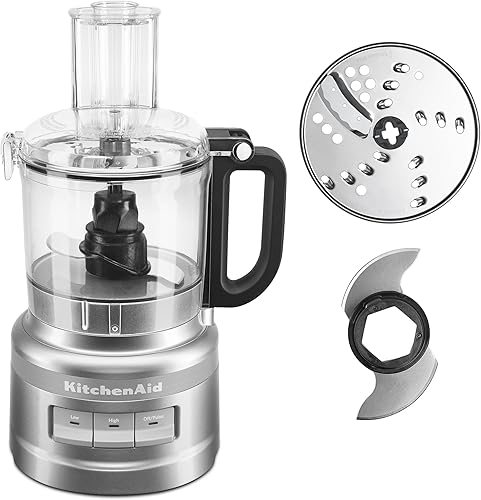
KitchenAid 7-Cup KFP0718: Best for tidy blade storage
- 7-cup work bowl
- Three speeds including pulse
- Reversible slicing and shredding disc
- Blades store inside the bowl
All blades and discs store inside the bowl, which keeps a small kitchen tidy between puree jobs. Three speeds give you more control over texture than a single button.
Pros
- Blades and discs store in the bowl
- Three speeds plus pulse
- One-click bowl assembly
Cons
- Purees need more manual pulsing than on preset models
KitchenAid's 7-cup machine suits a tidy kitchen where every accessory has a home. All the blades and discs store inside the bowl, so you're not hunting through drawers for the chopping blade.
The 7-cup bowl covers a family soup pot, and three speeds (high, low and pulse) give you more texture control than a single button, with easy-press paddles and illuminated LED controls. The reversible slice and shred disc and the 2-in-1 feed tube add prep options for tomatoes, cucumbers, potatoes and more.
KitchenAid also makes cleanup simpler than you'd expect. The bowl has a twist-free, one-click assembly and a latched lid, and the brand suggests adding warm water and a drop or two of dish soap to the leak-resistant bowl to clean the bowl and blades quickly.
Purees need more manual pulsing than a preset model, so it rewards a cook who likes to watch the texture and stop when it suits them.
La Reveuse Electric Food Processor: Best for seeing the puree texture
- 7-cup glass bowl
- 300W motor
- Two speed pulse control
- Whisking disc and spatula included
The glass bowl lets you watch the puree come together without lifting the lid. Two pulse speeds give you short bursts for a chunky or silky finish.
Pros
- Glass bowl shows texture as you work
- Two pulse speeds
- Whisking disc included
Cons
- 300W motor suits softer ingredients
- Hand wash only
La Reveuse is the pick if you like to see what's happening. The glass bowl lets you watch the puree build from chunky to smooth without lifting the lid.
Two pulse speeds give short bursts, which is useful for vegetables that can turn watery if processed too long. A 300W motor drives a two-layer stainless steel blade, and the machine is built to run quietly with an anti-slip rubber mat keeping the 7-cup bowl steady.
A whisking disc is included for eggs, and a spatula helps you scrape sticky puree from the sides. The bowl is BPA-free and comes apart fully for cleaning, though it is hand wash only.
The trade-off is that 300W is a gentler motor than the 450W and higher machines here. It suits cooked vegetables and softer ingredients rather than dense raw ones.
The motor also needs a longer rest if it overheats, roughly half an hour to an hour, which is worth knowing before you plan a long puree session. The glass bowl is heavier than plastic alternatives too.
BLACK+DECKER 8-Cup Food Processor: Best on a budget
- 8-cup work bowl
- 450W motor
- Low, high and pulse settings
- Reversible slice and shred disc
An 8-cup bowl and 450W motor cover everyday vegetable purees at a budget price. The lid doubles as the lock, which simplifies assembly.
Pros
- 8-cup bowl at a budget tier
- Low, high and pulse settings
- Reversible slice and shred disc
Cons
- No preset programs
- Lighter build than the Ninja models here
BLACK+DECKER's 8-cup model is the budget pick. It puts a usable 8-cup bowl and a 450W motor on the counter for less than the bigger brands, and it handles everyday vegetable purees without drama.
The smart design sets the work bowl on the base and uses the lid as the lock, which is quicker than twist-locking. Low, high and pulse settings give you basic texture control, and the reversible metal slice and shred disc adds prep work.
BLACK+DECKER lists salsas, hummus and nut butter among the jobs it suits, so it's a flexible budget machine beyond purees. The S-blade chops and mixes quickly and consistently for the price.
Its trade-offs are build and refinement. There are no presets, so pureeing is a manual job, and the lighter build doesn't feel as sturdy as the Ninja models.
All removable parts are dishwasher safe, which helps. If you puree several times a week and want the machine to last, the Ganiza or Ninja are safer long-term buys.
How these food processors were compared
We compared the machines on the things that change a vegetable puree: bowl materials, bowl size, motor power, speed and pulse control, and how easy each one is to clean. Our score weighs specs, features and buyer feedback against what you're shopping for.
Bowl material matters for two reasons. Stainless steel bowls are lighter and less likely to stain, while glass shows texture and resists scratches.
The Ganiza gives you both, which gives you more choice than most machines here. Choosing which bowl goes with which job is really a hygiene decision, and two bowls in different materials make that choice obvious at a glance.
Preset programs like Ninja's Auto-iQ help when you want a repeatable result. Manual models suit a cook who prefers to pulse and taste.
We treated both as valid routes to a good puree rather than ranking one above the other.
We also weighed warranty terms. Cuisinart's 3-year unit and 5-year motor cover stands out for long-term use, while the Ganiza covers its motor with a longer-life rating but publishes no warranty period in its product details.
Which bowl size do you need for pureeing vegetables?
Match the bowl to your biggest regular batch, not your smallest. A single cup of sauce is easy in any machine, but a pot of soup is where a small bowl becomes frustrating.
3 to 4 cups
The Hamilton Beach 3-cup is the sweet spot for single servings and baby food. Expect to run it several times for a family pot.
7 to 9 cups
Most households land here. A 7-cup bowl like the Cuisinart Pro Classic or KitchenAid covers a meal for two or three, while the Ganiza's 8-cup bowls and the Ninja 9-cup bowls take family portions.
A 9-cup bowl also leaves room to process a sauce and still have headroom for the blade to move food.
14 cups
Choose the 14-cup Cuisinart when you puree a whole stockpot or freeze batches. A smaller bowl forces you to process in runs, which is slower and heats the motor.
Does motor wattage matter for vegetable purees?
Cooked vegetables puree well in a mid-range motor, so wattage matters less than you'd expect for soft ingredients. A 300W to 450W machine handles soup vegetables with ease.
Higher wattage earns its keep on two jobs: raw or fibrous vegetables, and large batches. A 720W motor like the Cuisinart's, or a 1000-peak-watt Ninja, works faster through a full bowl and recovers more quickly between runs.
Wattage also shapes how long you can run without a pause. Keep an eye on long jobs, because most motors need a rest if they run hot.
Ganiza builds in overheating protection that pauses the motor rather than letting it burn out, and La Reveuse asks for a 30 to 60 minute rest after a protective stop.
Should you get presets or a manual machine for purees?
Presets suit cooks who want the same result every time. Manual pulse control suits cooks who stop by look and taste.
Neither is better in itself.
Preset machines
The Ninja PrecisionPro and BN601 offer one-touch pureeing. Press the program and the machine runs its cycle, which is handy for soup night and for cooks who don't want to hover.
Manual pulse machines
The Cuisinart, KitchenAid, Ganiza and La Reveuse models rely on you pressing or pulsing. That gives finer control over texture, and on a glass bowl you can watch the puree change as you go.
The Ganiza's two speeds let you start low on soft cooked vegetables, while the Cuisinart and KitchenAid three-way controls let you switch to pulse for the last few seconds.
Machines that offer both
The Ninja models are the only picks here with presets and manual speeds in one body. That matters if you want a repeatable soup on a weeknight and full control when you're experimenting.
If you mostly puree for soup and sauces and want repeatability, choose a preset machine. If you cook by feel, a pulse model rewards you.
What else do these processors do besides puree?
Most of these machines do more than purees, and the extras can matter more than the puree itself. Check which discs and blades come in the box before you choose.
For slicing and shredding, the Cuisinart 14-cup, Cuisinart 7-cup, Ninja models and BLACK+DECKER all include discs. They also make good food processors for chopping vegetables.
The Ninja picks add a dough blade, and the Cuisinart Pro Classic includes one too.
For nut butter, look at a high-wattage machine with a strong motor. Our guide to the best food processors for nut butter covers which ones hold up to long grinding.
If you also make dough, the Ninja PrecisionPro and the two Cuisinart models include a dough blade or dough-mixing setup. The Ganiza and La Reveuse are pure chopping tools, so plan for a separate mixer if baking is a regular job.
Which food processor is easiest to clean after a puree?
Dishwasher-safe bowls and blades save the most time. The Ninja PrecisionPro and BN601, the Ganiza and the BLACK+DECKER all list dishwasher-safe removable parts.
All of them are BPA-free.
Hand-wash models cost you time after every puree. The Cuisinart Pro Classic and La Reveuse recommend hand washing, which matters more with sticky squash or potato puree that clings to the bowl.
The KitchenAid and Cuisinart 14-cup sit in between, with dishwasher-safe parts listed.
For a fast cleanup routine, rinse the bowl and blade immediately after use before food sets. Warm water and a drop of dish soap in a KitchenAid bowl, as the brand suggests, can lift residue quickly.
The verdict on pureeing vegetables
For most kitchens, buy the Ganiza Food Processors with 2 Bowls. Two 8-cup bowls let you keep vegetable and meat prep apart, and the 450W motor with two speeds covers cooked carrots, squash and onions with ease.
Buy the Ninja PrecisionPro if you want a one-touch puree preset and slicing discs in one machine. Choose the 14-cup Cuisinart for stockpot batches, the 7-cup Cuisinart or KitchenAid for smaller kitchens, and the Hamilton Beach 3-cup for single servings.
The best food processor for pureeing vegetables is the one whose bowl fits your usual batch and whose cleaning routine you'll keep up with.
Our top 3 picks at a glance
-
1
Best for keeping veg and meat bowls apart
Ganiza Food Processors with 2 Bowls
9.6/10 our score
See it on Amazon -
2
Best for one-touch puree presets
Ninja PrecisionPro Food Processor & Dough Mixer
9.6/10 our score
See it on Amazon -
3
Frequently asked questions
Do I need a high-wattage motor to puree vegetables?
Not always. Cooked vegetables puree well in a 300W to 450W machine, which covers several picks here.
Higher wattage like the 720W and 1000-peak-watt models helps more with raw, fibrous vegetables and large batches.
Can a food processor puree soup as smooth as a blender?
A food processor can get cooked soup smooth, but it usually needs longer and may need scraping down the sides. Process in batches and leave room for hot liquid to expand.
For very silky results, a blender is often easier.
How full should I fill the bowl for a vegetable puree?
Leave headroom, roughly two thirds of the bowl for cooked vegetables and less for hot liquid. Overfilling stops the blade from moving the food and strains the motor.
Ganiza's overheating protection pauses the motor if a long job gets too warm.
What size food processor do I need for baby food?
A 3-cup to 7-cup bowl suits most baby food batches. A mini chopper like the Hamilton Beach 3-Cup works for single servings, while a 7-cup bowl covers a week of portions in fewer runs.


